
The last time I saw my father as a child, I was five years old.
I remember standing barefoot in front of our small house in Owerri, Imo State, clutching a broken doll while watching him walk away.
He never looked back.
At least, that’s how I remembered it.
For most of my life, I hated him for that moment.
I hated him for the tears my mother cried when she thought I was asleep.
I hated him for the birthdays he missed.
The school events he never attended.
The graduations where every other child had a father in the audience except me.
For twenty-four years, I carried that anger.
Then he appeared at my wedding carrying a single letter.
And everything I believed about my life changed.
My name is Chioma.
I was born in Imo State to an Igbo mother and a Yoruba father.
My mother, Ngozi, rarely spoke about him.
Whenever I asked questions, she would simply say:
“Forget him.”
“We are all we need.”
As a child, I accepted that answer.
As a teenager, I resented it.
As an adult, I grew obsessed with finding out why he had left.
All I knew was his name.
Adewale Akinyemi.
A Yoruba man from Oyo State.
According to my mother, he disappeared shortly after my fifth birthday.
No calls.
No letters.
No visits.
Nothing.
He vanished from our lives completely.
Growing up wasn’t easy.
My mother sold fabrics in Eke Ukwu Market.
She worked tirelessly to raise me.
Every achievement I had belonged as much to her as it did to me.
When I gained admission into university, she celebrated harder than I did.
When I graduated, she cried.
When I got my first job, she danced around the house like she had won the lottery.
She was my mother.
My father.
My entire world.
Still, there was always a hole inside me.
A question that never disappeared.
Why?
Why would a father abandon his child?
Over the years, I searched.
Social media.
Old records.
Family connections.
Anything.
But Adewale Akinyemi seemed to have disappeared.
Then one day, something unbelievable happened.
I was watching the evening news.
A traditional coronation ceremony was being broadcast from Oyo State.
Crowds filled the streets.
Drummers performed.
Chiefs stood proudly in ceremonial attire.
The reporter announced the installation of a new traditional ruler.
The camera focused on the king.
And my heart stopped.
The man on the screen looked exactly like the old photograph of my father.
Older.
Grayer.
But unmistakably him.
The caption beneath the screen read:
“His Royal Majesty, Oba Adewale Akinyemi.”
I nearly dropped the remote.
My father hadn’t disappeared.
He had become a king.
For several minutes, I simply stared at the television.
Trying to understand what I was seeing.
Questions flooded my mind.
If he was alive, why hadn’t he searched for me?
If he had become wealthy and influential, why had he never reached out?
Why had he left us behind?
My anger returned stronger than ever.
While my mother struggled to pay school fees, he was building a royal life.
While we suffered, he was becoming a king.
At least that’s what I believed.
Months later, I got engaged.
Wedding preparations began immediately.
Life became busy.
Eventually, thoughts about my father faded into the background again.
Then came the wedding day.
The church was overflowing.
Family members filled every seat.
Friends traveled from different states.
The atmosphere was joyful.
Beautiful.
Perfect.
The ceremony had just begun when whispers started spreading through the crowd.
People were turning toward the entrance.
Some looked shocked.
Others looked confused.
Then I saw him.
An elderly man dressed in elegant traditional Yoruba attire.
Surrounded by a small group of chiefs.
Walking slowly toward the front.
My father.
For a moment, the entire church seemed to disappear.
I could hear nothing.
Feel nothing.
Think nothing.
After twenty-four years, he stood before me.
The same man I had blamed for every unanswered question.
Every childhood wound.
Every painful memory.
My mother looked as stunned as I was.
The church fell silent.
Nobody knew what would happen next.
Would I throw him out?
Would I confront him?
Would I walk away?
Instead, he stopped several feet away.
And did something nobody expected.
He knelt.
A king.
An Oba.
A man respected by thousands.
Knelt before the daughter who hated him.
The entire church gasped.
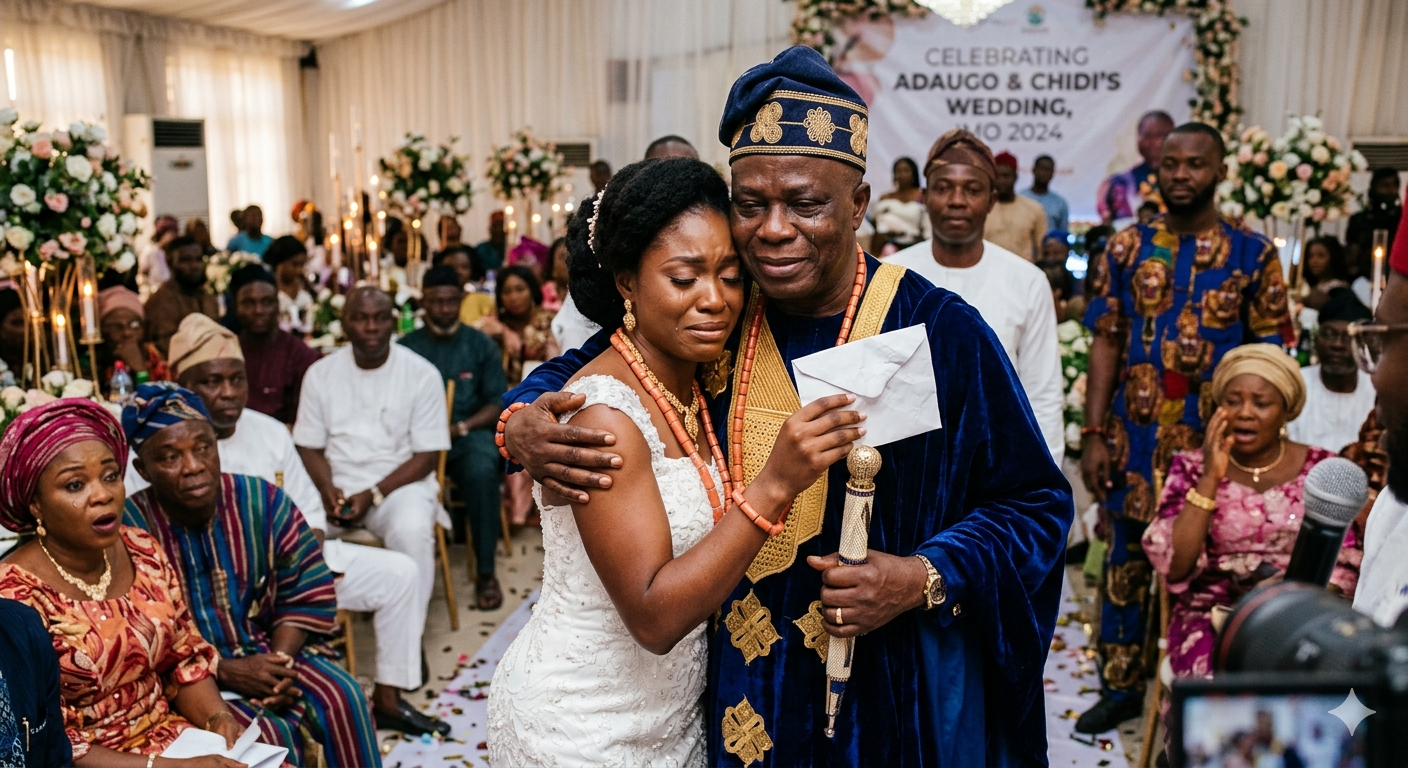
Then he extended a sealed envelope.
“My daughter,” he said.
His voice trembling.
“I know I have no right to ask anything from you.”
“But please read this.”
That was all.
He handed me the letter.
And stepped back.
My hands were shaking as I opened it.
Inside was a handwritten letter spanning several pages.
The handwriting looked unsteady.
As if written by someone carrying decades of pain.
The first sentence made my heart race.
“Chioma, I did not abandon you.”
I almost stopped reading.
But something forced me to continue.
The letter revealed a story I had never heard.
A story my mother herself didn’t know completely.
According to him, shortly after my fifth birthday, he became involved in a violent inheritance dispute within his extended family in Oyo State.
The conflict turned dangerous.
Very dangerous.
Threats were made.
Attacks occurred.
Several relatives were injured.
One family member was killed.
At the height of the crisis, he received warnings from security agencies.
People close to him were being targeted.
Including his wife and child.
Fearing for our safety, he made an impossible decision.
He left.
Not because he didn’t love us.
But because remaining connected to us could have put us in danger.
At first, I didn’t believe it.
Then I kept reading.
The letter contained copies of police reports.
Old court documents.
Newspaper clippings.
Official records.
Evidence supporting every claim.
My hands started trembling.
For years, I had imagined a selfish man walking away from his family.
Instead, the letter described a father watching from a distance.
A father secretly paying school fees through anonymous intermediaries.
A father receiving updates about his daughter’s life without ever being able to reveal himself.
A father who attended my university graduation disguised among the crowd.
A father who watched me receive awards from a distance.
A father who knew everything about me.
Tears blurred my vision.
Then came the paragraph that completely broke me.
“The day I became king was one of the happiest days of my life.”
“Not because I gained a throne.”
“But because the threats that kept me away from you were finally gone.”
“For the first time in decades, I was free to come find my daughter.”
By then, I was crying uncontrollably.
The final page contained one sentence.
One sentence that silenced the entire church.
“Every day for twenty-four years, I prayed that you would one day hear my side before judging my silence.”
I looked up.
The old man standing before me wasn’t the villain I had imagined my entire life.
He wasn’t perfect.
He had made mistakes.
Painful mistakes.
But he wasn’t the monster I had created in my mind.
He was a father carrying decades of regret.
Without thinking, I walked toward him.
And hugged him.
The church erupted into tears.
My husband cried.
My mother cried.
Even some of the guests cried.
For several minutes, neither of us could speak.
When I finally pulled away, I asked the question I had carried since childhood.
“Did you ever stop loving me?”
His answer came immediately.
“Never.”
Today, my father and I are rebuilding a relationship that should never have been broken.
It isn’t perfect.
Lost years can never be recovered.
Missed birthdays can never be relived.
Childhood memories can never be recreated.
But forgiveness has given us something else.
A future.
And every time I look at the framed letter hanging in my living room, I remember one powerful truth:
Sometimes the stories we tell ourselves about people are not the whole story.
Sometimes the truth arrives decades late.
And sometimes a single letter can change an entire lifetime of anger.
Source: Original This story is inspired by the real experiences of our readers. We believe that every story carries a lesson that can bring light to others. To protect everyone’s privacy, our editors may change names, locations, and certain details while keeping the heart of the story true. Images are for illustration only. If you’d like to share your own experience, please contact us via email.