

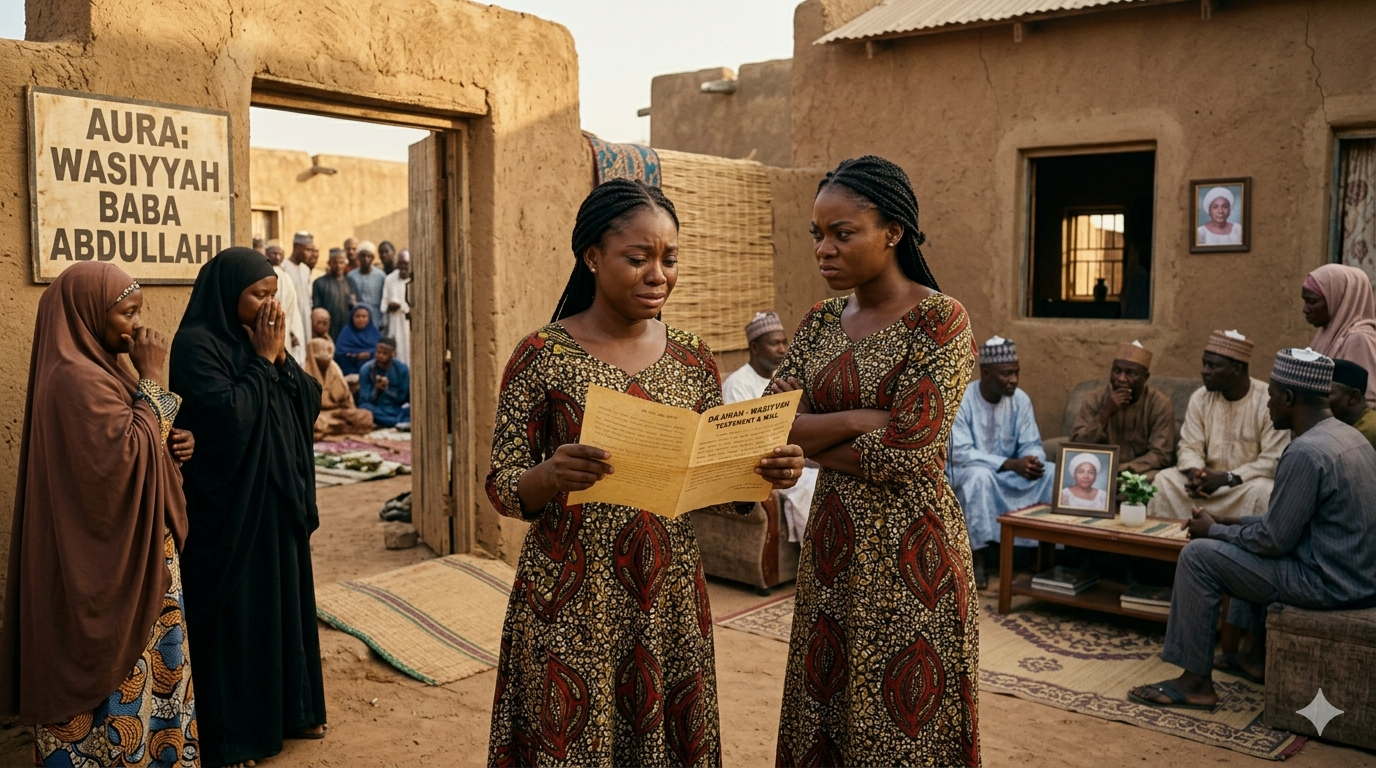
My name is Zainab.
I have an identical twin sister named Zahra.
For most of our lives, people struggled to tell us apart.
We wore the same clothes, attended the same schools, and finished each other’s sentences.
As children, we were inseparable.
As adults, we became strangers.
And by the time our father died, my own twin hated me enough to keep me away from his funeral.
What she didn’t know was that our father had already seen everything coming.
And he had left behind one final surprise.
We grew up in Kano in a respected Hausa family.
Our father, Alhaji Musa, was a successful businessman.
He wasn’t rich enough to own private jets or mansions abroad, but in our community, his name carried weight.
More importantly, he was a fair man.
At least, he tried to be.
Whenever Zahra and I fought as children, he never took sides.
Whenever one of us succeeded, he celebrated both of us.
He often said:
“Twins are two eyes in the same face. If one eye cries, the other cannot truly smile.”
Back then, I believed it.
I thought nothing could ever come between us.
I was wrong.
The problems started after university.
I moved to Abuja and built a career in accounting.
Zahra stayed in Kano and joined our father’s business.
At first, everything seemed normal.
Then our father began trusting her with more responsibilities.
She handled company accounts.
She signed documents.
She attended meetings on his behalf.
Gradually, she became his closest adviser.
I was happy for her.
Or at least I tried to be.
But something changed.
Every year, Zahra became more possessive.
More controlling.
More suspicious.
Whenever I visited home, she acted as though I were an outsider.
At family gatherings, she made subtle comments.
“Some people only remember their family when they need something.”
Or:
“It’s easy to love a business you never worked for.”
At first, I ignored it.
Then it got worse.
When our mother died, our relationship deteriorated completely.
There was an argument over family property.
Nothing major.
Just a misunderstanding.
But Zahra treated it like betrayal.
From that day forward, she stopped taking my calls.
She ignored my messages.
She blocked me everywhere.
For nearly four years, we barely spoke.
The only person connecting us was our father.
Every Sunday, he called me.
Every Eid, he made sure I visited.
Whenever I complained about Zahra, he would smile sadly.
“One day she will understand.”
I didn’t know what he meant.
Then, last year, our father became ill.
At first, doctors said it was manageable.
Months later, they discovered cancer.
The diagnosis devastated us.
I immediately began traveling to Kano whenever possible.
But Zahra controlled access to him.
Sometimes she claimed he was resting.
Other times she said he wasn’t feeling well.
Several visits ended with me sitting in the living room while she refused to let me see him.
I felt helpless.
Yet somehow, my father always found ways to reach me.
He called.
He sent messages.
He reassured me.
And every conversation ended the same way.
“Don’t worry. Everything will be okay.”
Then came the phone call.
The one every child fears.
My father had died during the night.
I broke down immediately.
The next available flight from Abuja was several hours away.
I packed my bags and headed for the airport.
Halfway there, my cousin called.
His voice sounded uncomfortable.
“Zainab…”
“Yes?”
“There is a problem.”
My stomach tightened.
“What problem?”
He hesitated.
Then he said words I’ll never forget.
“Zahra has told everyone not to allow you near the funeral.”
I nearly dropped my phone.
“What?”
“She says you abandoned the family. She says Baba didn’t want you involved.”
I felt physically sick.
When I arrived in Kano, the situation was worse than I imagined.
Several relatives avoided eye contact.
Others repeated Zahra’s version of events.
Apparently, she had spent months telling people I only cared about inheritance.
That I rarely visited.
That our father was disappointed in me.
None of it was true.
But grief makes people vulnerable to manipulation.
And Zahra had positioned herself as the devoted daughter who stayed.
By the time I arrived, the narrative was already established.
I wasn’t welcome.
At my own father’s funeral.
I stood outside the family compound and watched from a distance.
I wasn’t allowed inside.
I wasn’t allowed to participate.
I wasn’t even allowed to say goodbye.
The pain was indescribable.
I cried until my head ached.
Not because my father was gone.
But because I couldn’t honor him properly.
And because the person responsible was my own twin sister.
Three days later, our father’s lawyer contacted the family.
There was a will.
Everyone gathered for the reading.
Including Zahra.
She arrived confident.
Almost triumphant.
I suspect she believed everything had gone according to plan.
She controlled the business.
She controlled the family narrative.
And soon, she expected to control the inheritance.
The lawyer opened the document.
Then he began reading.
The room fell silent.

The first line changed everything.
It read:
“To my beloved daughters, Zainab and Zahra, whom I love equally, I leave this declaration: Any claim that one daughter loved me more than the other is false and should be rejected immediately.”
The room froze.
My heart stopped.
The lawyer continued.
“If you are hearing this, it means I am no longer here to defend the truth. Therefore, let it be known that both my daughters cared for me, supported me, and remained precious to me until my final breath.”
I looked at Zahra.
For the first time all week, she seemed nervous.
Then the lawyer read further.
My father had documented everything.
Letters.
Messages.
Records of my visits.
Evidence that he had repeatedly asked to see me.
Evidence that I had contributed financially to his treatment.
Evidence that he had complained about being used as a weapon in family disputes.
Every accusation against me collapsed.
One by one.
In front of everyone.
But my father’s final instruction was the most shocking.
He ordered that all major family assets remain jointly owned by both daughters.
Neither could sell, transfer, or control them without the other’s approval.
The room erupted in murmurs.
Zahra looked stunned.
Years of maneuvering vanished in seconds.
After the reading ended, relatives who had ignored me suddenly approached with apologies.
Some cried.
Others admitted they had believed the rumors.
I accepted their apologies.
But the only one that mattered never came.
Not that day.
Two months later, Zahra showed up at my hotel in Abuja.
I almost didn’t open the door.
When I did, I barely recognised her.
The confidence was gone.
The anger was gone.
For the first time in years, she looked like my sister again.
She sat down and cried.
For nearly twenty minutes.
No speeches.
No excuses.
Just tears.
Finally, she spoke.
“I was jealous.”
The words sounded strange coming from her.
She explained that she had always felt abandoned after I left Kano.
While I built a career and traveled, she remained home carrying responsibilities she never wanted.
Resentment grew.
Then grief made it worse.
By the time our father died, she wasn’t thinking clearly.
She was acting from years of buried anger.
We talked until midnight.
Not every wound healed that night.
Some scars remain.
But it was a beginning.
And sometimes a beginning is enough.
Today, when people ask about my father’s greatest gift, they assume I mean the inheritance.
I don’t.
The greatest gift wasn’t money.
It wasn’t property.
It wasn’t business shares.
It was wisdom.
My father understood something neither of his daughters could see.
The real threat to our family wasn’t death.
It was division.
And with the first line of his will, he defeated it.
Even from the grave.
My twin sister tried to erase me from our father’s final chapter.
Instead, his very first words ensured I would never be forgotten.