

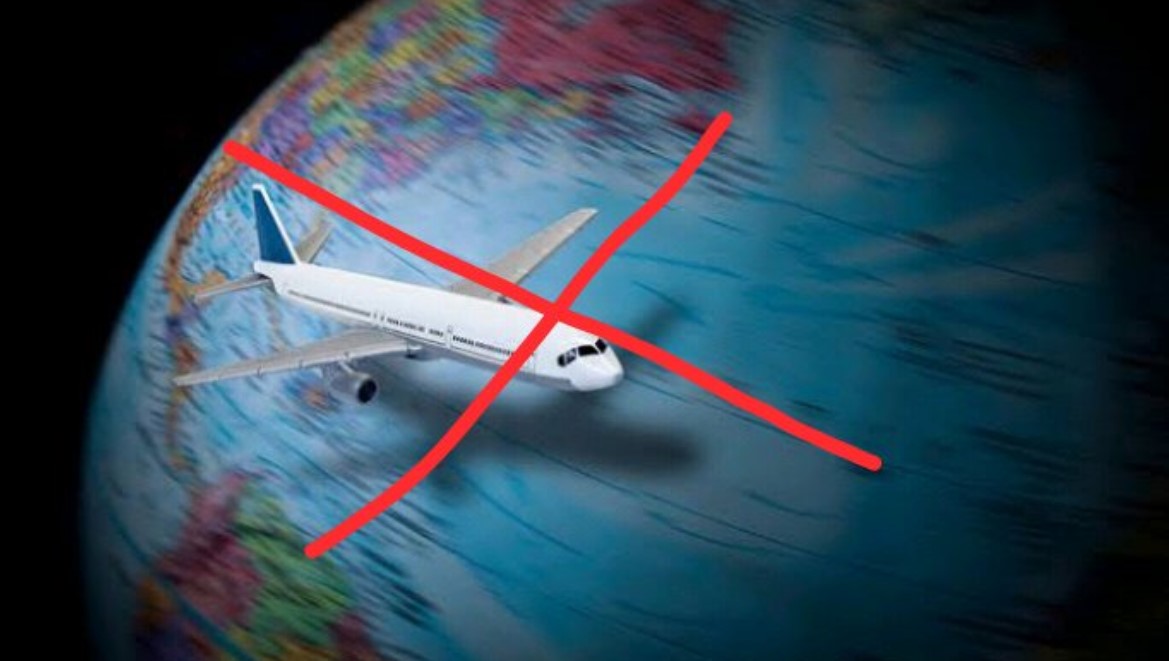
The article explains common misconceptions about flight routes over the Pacific Ocean and provides reasons why commercial aircraft often appear not to fly directly across it. It begins by noting that many frequent travelers assume planes avoid the Pacific due to unusual or unexplained reasons, but it clarifies that such assumptions are generally incorrect. Instead, the routing of aircraft is guided by practical aviation and economic considerations.
One of the key points discussed is that flight paths are not always drawn as straight lines on a flat map. The article explains that Earth is spherical, and because of this, the shortest route between two points is not always a straight line when viewed on a traditional flat map projection. Instead, aircraft follow what are known as curved or “great circle” routes, which represent the shortest distance over the Earth’s surface. These routes may appear curved or indirect on maps, but they are actually the most efficient paths in real-world navigation.
The article also emphasizes that airlines prioritize efficiency in terms of fuel consumption, time, and overall operational cost. Flight planners calculate routes that reduce fuel usage and minimize travel time, even if these paths seem less direct on a map. This means that when traveling between continents such as North America and Asia, aircraft often follow routes that curve over regions like the Arctic or northern parts of the Pacific rather than flying straight across the central ocean.
Another explanation provided is that aviation systems rely on optimization strategies that balance safety, weather conditions, air traffic control regulations, and fuel efficiency. These factors can influence flight paths significantly. Weather patterns, jet streams, and emergency landing considerations also play a role in determining the safest and most efficient route for long-distance flights.
The article further clarifies that it is not true that planes completely avoid the Pacific Ocean. In reality, many international flights do cross large portions of it, depending on the origin and destination cities. However, the routes may not always appear direct on conventional maps, leading to the misconception that the ocean is being avoided.
In conclusion, the article highlights that modern aviation is driven by mathematical route optimization and practical efficiency rather than myths or unusual restrictions. The perceived avoidance of straight paths over the Pacific is mainly a result of map distortion and the use of curved flight routes designed to save time and fuel.