
During General Sani Abacha’s repressive regime (1993–1998), few names inspired as much fear and dread as Sergeant Barnabas Jabila Mshelia, popularly known as Sergeant Rogers. A member of the elite Strike Force unit commanded by Major Hamza Al-Mustapha, Rogers was not just any soldier — he was a highly trained sharpshooter who became the regime’s most effective weapon against perceived enemies.
Rogers was among 26 Nigerian soldiers secretly sent to North Korea in 1994 for advanced marksmanship and special operations training. He was the only one who passed the gruelling course with distinction, earning a reputation for deadly accuracy — the ability to hit a moving target with a single bullet from a long distance.
The Brutal Assassination of Kudirat Abiola
Rogers’ most infamous operation was the cold-blooded assassination of Alhaja Kudirat Abiola, the fearless wife of the late Chief M.K.O. Abiola, on June 4, 1996.
Kudirat had become a major thorn in Abacha’s flesh. She led high-profile protests, granted damning international interviews, and relentlessly campaigned for the release of her husband, who had been detained after declaring himself president following the annulled June 12, 1993 election.
On that fateful day, as Kudirat’s white Mercedes-Benz S-Class was driving along Oregun Road in Lagos, a blue Mercedes 190 overtook her vehicle. Sergeant Rogers, positioned strategically, rose through the sunroof and opened fire. The first shots shattered the glass. As Kudirat instinctively turned her head, Rogers fired the fatal bullet directly into the centre of her forehead, killing her instantly. Her driver was also seriously injured.
The assassination sent shockwaves across Nigeria and the world, highlighting the regime’s willingness to eliminate anyone who dared to challenge it.
The Explosive Confession at the Oputa Panel
After Abacha’s sudden death in 1998, the dark secrets of his regime began to unravel. Under President Olusegun Obasanjo’s administration, the Oputa Panel (Human Rights Violations Investigation Commission) was set up in 1999 to investigate abuses during the military era.
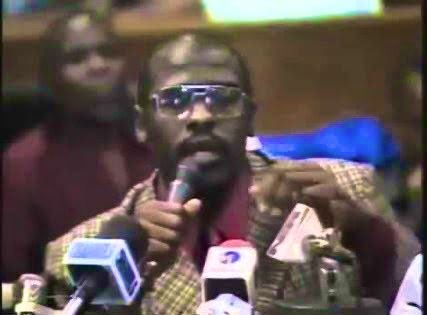
In one of the most dramatic moments of the hearings, Sergeant Rogers appeared before the panel and gave a chilling, matter-of-fact testimony that left the entire nation stunned. He openly admitted his role in several high-profile assassinations and attempted killings, describing them with clinical precision.
Watch his appearance at the Oputa Panel below;
Rogers confessed that he received direct orders from the highest levels of the Abacha regime. He revealed how he and his team were given detailed intelligence on targets, including Kudirat Abiola. He named Lateef Shofolahan, Kudirat’s protocol officer, as the person who betrayed her by feeding information to the Strike Force.
With a calm demeanour that sent shivers down the spines of those watching, Rogers narrated how he executed the operation, the type of weapons used, and how the team escaped after the hit. He also admitted involvement in other killings and attempts on the lives of prominent pro-democracy figures.
His testimony provided rare insight into how state-sponsored death squads operated during the Abacha years. While some viewed him as a mere executor of orders, many Nigerians saw him as the face of a brutal machinery of terror.
Legacy of Fear and Infamy
After his testimony, Rogers largely disappeared from public view. The revelations, however, cemented his place in history as one of the most feared assassins of Nigeria’s military era. The Strike Force he belonged to became synonymous with extrajudicial killings, intimidation, and absolute loyalty to Abacha.
The story of Sergeant Rogers remains a dark reminder of how power, when left unchecked, can turn ordinary soldiers into instruments of death and fear. It also highlights the courage of figures like Kudirat Abiola, who paid the ultimate price for demanding justice and democracy.
Even decades later, his name still evokes strong emotions — a symbol of both the brutality of military dictatorship and the painful struggle for freedom in Nigeria.
Source: Testimony of Sergeant Rogers at the Oputa Panel, historical narrations by @omolokun1, and archival reports from Premium Times, The Guardian, and Punch Newspapers.
What do you think about Sergeant Rogers’ confession and the role of the Strike Force? Share your thoughts in the comment section.