
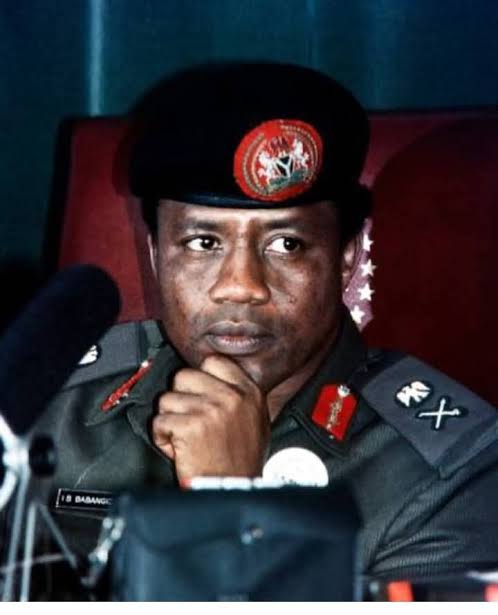
The August 27, 1985 coup that removed General Muhammadu Buhari remains one of the most meticulously planned and smoothly executed military takeovers in Nigerian history. At the centre of its success was Major General Ibrahim Babangida’s ability to secure the loyalty of almost every strategic unit — most critically, the elite Presidential Brigade of Guards.
There was only one major exception: Lt. Col. Abdulazeez Sabo Aliyu, the Commander of the Brigade of Guards.
Background and Preparation
By mid-1985, relations between Buhari and his Chief of Army Staff, Babangida, had become severely strained. Babangida and his allies (including Sani Abacha, Aliyu Mohammed Gusau, Halilu Akilu, and others) had been quietly building support across the military for months. They cultivated loyalty among key battalion commanders, intelligence officers, and influential course-mates from the Nigerian Defence Academy.
The Brigade of Guards, responsible for protecting the Head of State and Dodan Barracks, was the most critical unit. Winning it over — or at least neutralizing it — was non-negotiable for the coup’s success.
Babangida’s team worked methodically. They successfully recruited or swayed the commanders of the 6th Guards Battalion (Bonny Camp), 123rd and 93rd Battalions, and the Guards Garrison at Obalende. These officers were either brought into the plot or quietly switched sides as the D-day approached.
The Lone Holdout: Lt. Col. Sabo Aliyu
Lt. Col. Sabo Aliyu, a thorough and loyal officer, remained firmly committed to Buhari. As overall Commander of the Brigade of Guards, he sensed that something unusual was brewing. On several occasions in the days and hours leading up to the coup, he pressed his friend and course-mate, Lt. Col. Halilu Akilu (Director of Military Intelligence), for information. Akilu consistently reassured him that nothing was amiss.
Despite his suspicions, Sabo Aliyu found himself increasingly isolated. Most of his subordinate commanders had already aligned with Babangida. When the coup was finally launched in the early hours of August 27, the Brigade of Guards was effectively compromised from within.
While Sabo Aliyu attempted to rally resistance and sought clarification by moving between Ikoyi, Victoria Island, and Ikeja, he was eventually overpowered by the momentum of the well-coordinated operation. Historical accounts indicate he was arrested or sidelined as Babangida’s forces took control of key positions.
Outcome and Significance
With the Brigade of Guards largely neutralised (except for Sabo Aliyu’s personal resistance), the coup proceeded with minimal bloodshed. By morning, Brigadier Joshua Dogonyaro announced the change of government on national radio. Buhari was arrested, and Babangida emerged as the new Head of State.
Sabo Aliyu’s lone stand became a notable footnote in the story of the 1985 coup — a symbol of loyalty in the face of widespread defection. His resistance, though ultimately unsuccessful, highlighted the internal tensions and personal dilemmas officers faced during that turbulent period.
Babangida’s strategic cultivation of the Brigade of Guards proved decisive. By winning over almost every key officer except the overall commander, he ensured that the most elite protective unit in the country would not mount any serious opposition.
This pattern of securing the Presidential Brigade of Guards would repeat itself in later power shifts, underscoring the unit’s enduring importance in Nigerian military politics.
The 1985 coup, often described as a classic “palace coup,” succeeded largely because Babangida understood one fundamental truth: in Nigerian power games, controlling the guards who protect the leader is often more important than controlling the leader himself.
Sources:
– Gamji.com historical archives
– Dawodu.com (extensive accounts of the 1985 coup)
– The Historyville and other documented Nigerian military history records
What do you think about Lt. Col. Sabo Aliyu’s lone resistance? Share your thoughts in the comment section.