
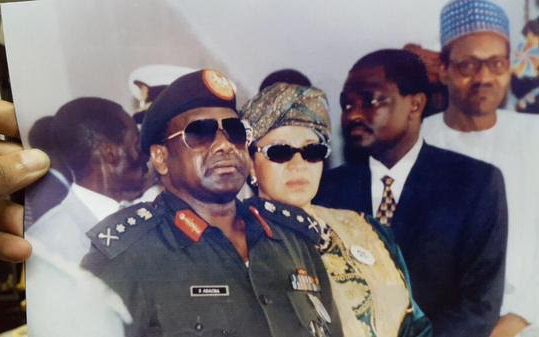
In December 1997, the heart of General Sani Abacha’s regime was rotting from within. A group of very senior military officers, including some of his closest allies, gathered secretly at Aguda House — the official residence of Lt. General Oladipo Diya, the Chief of General Staff and Abacha’s deputy. Their mission was clear and deadly: overthrow and eliminate Abacha himself.
Among the conspirators were Lt. General Ishaya Bamaiyi (Chief of Army Staff), Major General Abdulkarim Adisa, Major General Patrick Aziza, and several Brigade of Guards commanders. The plan was bold. Bamaiyi suggested using a Rocket-Propelled Grenade (RPG) to blow up Abacha’s vehicle on his way to the mosque. When Adisa raised concerns about civilian casualties, Diya reportedly shut him down, telling him to let Bamaiyi handle the military details.
What the plotters did not realise was that they had already been betrayed — and Abacha was playing them like pawns.
The Double Agent and the Trap
Unbeknownst to Diya and the others, Bamaiyi had gone to Abacha two weeks earlier and revealed the entire conspiracy. He claimed he had only pretended to join the plot to expose it. Abacha, a master of survival and paranoia, saw an opportunity. He instructed his loyal Chief Security Officer, Major Hamza Al-Mustapha, to work closely with Bamaiyi and “play along” with the conspirators while feeding them false information.
From that moment, the coup plot became a carefully orchestrated theatre directed by Abacha himself. Bamaiyi continued attending secret meetings, giving the impression that the plan was progressing. Meanwhile, Abacha was receiving real-time updates. When Diya sent his own Chief Security Officer to monitor Abacha’s movements for a planned abduction in Enugu, Abacha deliberately toyed with them — leaving Aso Rock and then suddenly returning, leaving the plotters confused and off-balance.
The Dramatic Collapse
On December 21, 1997, Abacha struck without warning. Diya, Adisa, and several other high-ranking officers were arrested in a swift, clinical operation. The coup plot, which had seemed so close to execution, collapsed spectacularly. The accused were dragged before a military tribunal where the full weight of Abacha’s wrath was unleashed.
The episode exposed the deep rot of suspicion and betrayal that defined Abacha’s final years in power. Even his own deputy and top generals could no longer be trusted. Abacha’s ability to turn the conspiracy against the conspirators became legendary — a chilling demonstration of how he maintained control through superior intelligence, manipulation, and ruthless counter-intelligence.
Legacy of Paranoia and Power
This 1997 incident remains one of the most dramatic “coup within a coup” stories of Nigeria’s military era. It showed Abacha at his most dangerous: patient, calculating, and always several steps ahead. His handling of the plot reinforced the regime’s reputation for brutality while also highlighting the constant fear that haunted even the most powerful men around him.
For many observers, the event marked the beginning of the end for Abacha’s inner circle. Trust evaporated completely. Officers began looking over their shoulders, wondering who was the next double agent. The atmosphere of paranoia that followed contributed to the instability that many believe accelerated the regime’s eventual collapse after Abacha’s sudden death in June 1998.
Abacha’s mastery in dismantling the 1997 coup plot stands as a dark but fascinating chapter in Nigerian history — a reminder of how absolute power breeds betrayal, and how one man’s survival instincts could keep an entire nation in a vice grip for years.
Source: Historical narration credited to @omolokun1 (as featured in the Instagram reel by current_andconvo) and documented accounts of the Abacha era.
What do you think about the level of betrayal and counter-intelligence during Abacha’s regime? Share your thoughts in the comment section.