
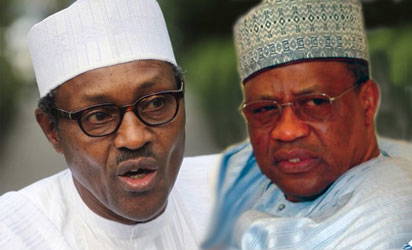
In the final months of his regime in 1985, Major General Muhammadu Buhari already knew that his Chief of Army Staff, Major General Ibrahim Babangida, was planning to remove him from power. When asked years later why he didn’t retire Babangida to prevent the coup, Buhari gave a short but telling reply:
“[Babangida] can move, [I can’t].”
This statement revealed the deep strategic imbalance between the two powerful officers. But their story went far beyond that single moment. It was a relationship shaped by shared military history, family ties, rivalry, and political calculations that spanned decades.
How Their Paths Crossed
Buhari and Babangida’s paths first crossed meaningfully during the Nigerian Civil War (1967–1970). While Buhari fought as an infantry officer on the war front, Babangida served in the Armoured Corps. Both emerged from the war as ambitious and respected young officers.
Their relationship deepened after the 1975 coup that brought General Murtala Mohammed to power. Babangida played a prominent role in that coup, while Buhari was appointed Military Governor of Borno State. By the time General Olusegun Obasanjo took over after Murtala’s assassination in 1976, both men had become key players in the Supreme Military Council.
When Buhari staged the December 1983 coup that overthrew President Shehu Shagari, Babangida was one of his strongest supporters and was rewarded with the powerful position of Chief of Army Staff. At that point, many believed the two men were close allies who would work together to “correct” the ills of the Second Republic.
Within months of the regime, personal ambitions and differences in style began to strain the bond. Buhari was known for his rigid, no-nonsense approach, while Babangida was more calculating, sociable, and politically flexible.
The 1985 Coup and the Fallout
By mid-1985, Babangida had quietly built a strong network within the Armoured Corps. Many key officers owed their careers to him. Buhari, an infantry officer, did not have the same level of control over this critical fighting arm of the military.
When Babangida eventually struck on August 27, 1985, the coup was swift and relatively bloodless. Buhari was placed under house arrest. Though he was later released, the experience left him deeply bitter. For years, he maintained a cold distance from Babangida.
Life After Government
After losing power in 1985, Buhari largely stayed away from public life for many years. He only returned to active politics in 2023 when he contested for president under the ANPP. He would go on to contest again in 2007 and 2011 before finally winning in 2015 under the APC.
Babangida, on the other hand, ruled Nigeria from 1985 to 1993. His regime was marked by both economic reforms and political controversies, especially the annulment of the June 12, 1993 presidential election. After stepping aside, he remained a powerful behind-the-scenes figure in Nigerian politics for decades.
Why Buhari Didn’t Go After Babangida in 2015
When Buhari finally returned as a civilian president in 2015, many expected him to settle old scores with Babangida. Surprisingly, he did not.
There were several reasons for this:
First, Buhari had campaigned on the slogan “I belong to everybody and I belong to nobody.” Going after Babangida would have contradicted this message of national reconciliation. It would have been seen as vindictive and could have destabilised his early days in office.
Second, Babangida still wielded considerable influence within the military and political class. Many senior officers and politicians had benefited from his long years in power. Pursuing him could have created unnecessary enemies within the system Buhari needed to work with.
Third, Buhari appeared more focused on fighting corruption among politicians of the immediate past (especially those from the Jonathan era) rather than reopening old military wounds. Going after Babangida would have opened a Pandora’s box of questions about all previous military regimes, including his own.
Finally, age and political maturity seemed to have played a role. By 2015, both men were in their seventies. Buhari appeared more interested in leaving a legacy of fighting insurgency and corruption than settling personal scores from 30 years earlier.
The Complicated Legacy
The relationship between Buhari and Babangida remains one of the most complex in Nigeria’s military and political history. They were once allies who later became rivals.
Even in retirement, both men continued to command respect and influence in different ways. While Buhari finally achieved his long dream of becoming a civilian president, Babangida remained a master political strategist who knew when to step back and when to exert quiet influence.
Their story is a reminder that in Nigerian politics and military history, personal relationships, strategic calculations, and the pursuit of power often intersect in complicated ways.
Source: Historical accounts and interviews with both leaders over the years.
- Gamji.com historical archives
- Dawodu.com (extensive accounts of the 1985 coup)