War is what happens when language fails.” – Margaret Atwood Some wars are remembered through speeches, newspaper headlines and official documents. Others live on in the haunting faces of soldiers, refugees, starving children and shattered towns captured in photographs.
The Nigerian Civil War, fought between 1967 and 1970, belongs to both worlds.
In this post, we journey back into one of the darkest periods in Nigeria’s history through emotional photographs taken during the conflict popularly known as the Biafran War.
These images do more than preserve moments; they tell stories of courage, suffering, propaganda, survival and the heavy human cost of war.
Decades later, they still speak with a silence louder than words.
JULY: Colonel Emeka Ojukwu, the Biafran secession leader in front of a map during the Biafra war in Nigeria in July 1968. (Photo by Fondation Gilles CARON/Gamma-Rapho via Getty Images)
Troops from the Nigerian Federal Army marching along a road after routing Biafran troops at Port Harcourt during the Biafran War. (Photo by Express Newspapers/Getty Images)
21st May 1968: John Downing-Tractor, a company rep, and William Blakeley, a marine manager, under guard by Nigerian Federal troops who took them hostage when they captured Port Harcourt during the Biafran War. (Photo by Terry Fincher/Express/Getty Images
A starving Biafran family during the famine resulting from the Biafran War.
A federal soldier swings a hand grenade by its release pin while guarding Ibo women prisoners and their children in Nigeria, during the Biafran War. (Photo by Keystone/Getty Images)
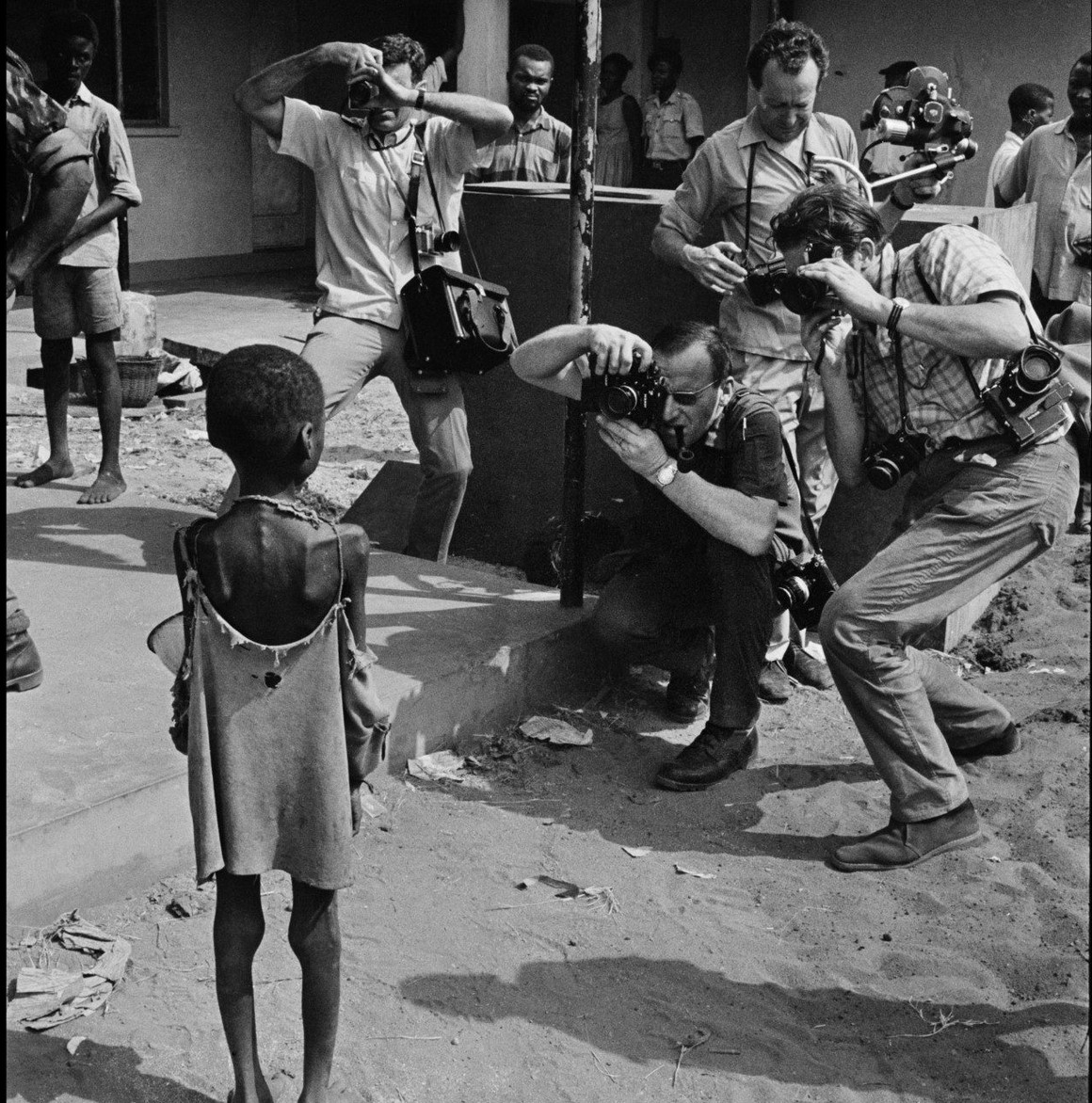
Starving child crying with hunger at the Queen Elizabeth Hospital, Umuahia just a few of the estimated one to two million victims of the Biafran War, 23rd June 1968. (Photo by Ron Burton/Mirrorpix/Getty Images)
Africa, Nigeria civil war, Biafra, a Nigerian prisoner taken by the Biafran forces. (Photo by Romano Cagnoni/Getty Images)
Nigerian troops entering Port Harcourt, after routing Biafran troops during the Biafran War. (Photo by Evening Standard/Getty Images)
A Biafran soldier seen here helping an old lady from the wreckage of her home following a artillery bombard by the Nigerian army, 11th June 1968 . (Photo by Ron Burton/Mirrorpix/Getty Images)
Nigerian Federal Troops in command of Port Harcourt after routing Biafran troops, during the Biafran War.
Nigerian federal army soldiers (R), prisoners of the Biafran army, wait to be questioned, on August 08, 1968 near Ikot Ekpene during the Biafran war. A civil war opposing Biafra secessionnist tribes fighting for independance and the federal troops killed between one and two milllion people, most from hunger and disease, from 1967 to 1970 in the Biafra region in south-eastern Nigeria. (Photo by AFP) (Photo by -/AFP via Getty Images)
A Biafran mother and child suffer from starvation during the war. (Photo by Partington/Getty Images)
Nigerian firefighters extinguish the fire at the Casino Cinema after a fuel tanker (wreckage in the foreground) loaded with fuel and explosives was detonated as people were entering the building in Yaba, a suburb of Lagos, Nigeria, 19th July 1967. The attack was part of the Nigerian Civil War (also known as the Nigerian-Biafran War or the Biafran War), between Nigeria and secessionist state, the Republic of Biafra. (Photo by Central Press/Hulton Archive/Getty Images)
View of a young male soldier from the Republic of Biafra crouching in a foxhole with a rifle during the Nigerian – Biafran civil war in Nigeria in August 1968. Members of the Igbo tribe rebelled in 1967 to demand a separate Republic of Biafra. The war and famine lasted until 1970, when the Biafran Republic forces surrendered to the nationalist government. (Photo by Rolls Press/Popperfoto/Getty Images)
NIGERIA – 1968: Wedding of an officer of the Ibo ethnic group during the Biafran War in 1968 in Nigeria. (Photo by Fondation Gilles CARON/Gamma-Rapho via Getty Images)
Soldiers posing in front of a captured plane, during the Nigerian conflict with Biafran forces, Nigeria, 1968. (Photo by Terry Fincher/Express/Getty Images)
An airport worker takes care of a little refugee during his arrival at Santa-Isabel Airport, Bioko Island, Equatorial Guinea, as part of the Airlift effort helping Biafrans fleeing the Nigeria-Biafra war (1967–1970). Photo: Max Vaterlaus
Nigerian Army Commander Benjamin Adekunle with his troops, looking at a map of Port Harcourt during the conflict with Biafran forces, 19th May Nigeria, 1968. (Photo by Terry Fincher/Express/Getty Images)
TO GO WITH AFP STORY IN FRENCH BY JOEL OLATUNDE AGOI (FILES) File picture showing refugees carrying their belongings as they flee the city of Aba,on their way to Umuahia, then the new capital of the Republic of Biafra,on 01 September 1968. A civil war opposing Biafra secessionnist tribes fighting for independance and the federal troops killed between one and two milllion people from 1967 to 1970 in the Biafra region in south-eastern Nigeria. Nigerian high school students will study the Biafran war, an aspect of Nigerian history only in final year in school and two sessions. AFP PHOTO FRANCOIS MAZURE/FILES (B/W ONLY) (Photo credit should read FRANCOIS MAZURE/AFP/Getty Images)
Nigerian leader General Yakubu Gowon (R) welcomes United Nations Secretary General U Thant (L) who flied into Lagos to hold talks over the continuing Biafran refugee crisis, on January 19, 1970 at Ikeja airport, during the Biafra war. A civil war opposing Biafra secessionnist tribes fighting for independance and the federal troops killed between one and two milllion people, most from hunger and disease, from 1967 to 1970 in the Biafra region in south-eastern Nigeria. / AFP / – (Photo credit should read -/AFP/Getty Images)
A dead body abandoned in a field, during the Nigerian conflict with Biafran forces, Nigeria, 1968. (Photo by Terry Fincher/Express/Getty Images)
The Nigerian Civil War officially came to an end on January 15, 1970, after Biafran leader Lt. Col. Chukwuemeka Odumegwu Ojukwu fled into exile and his deputy, Major General Philip Effiong, formally surrendered to the Federal Military Government led by General Yakubu Gowon.
Gowon’s famous declaration of “No victor, no vanquished” was meant to begin the difficult process of healing and rebuilding a deeply divided nation.
Yet, decades later, the war remains one of the most emotional and controversial chapters in Nigeria’s history. The photographs above are more than historical records; they are silent witnesses to the suffering, sacrifice and resilience of millions of people whose lives were forever changed by the conflict.
Through them, the memories of the war continue to live on, reminding present and future generations of the terrible cost of division and the enduring importance of peace.