

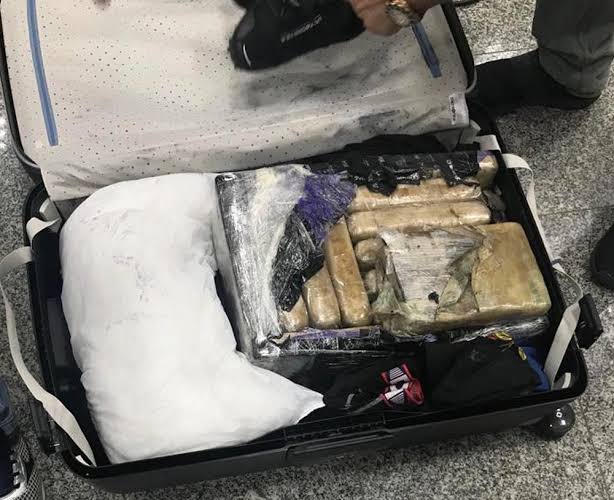
A 37-year-old South African woman, Asandra Denise, has been handed a staggering 130-year prison sentence in Sierra Leone after being convicted of cocaine trafficking — a punishment so severe that many are now asking whether anti-South African sentiment, fueled by xenophobia, played a role in the judgment.

The convict, a resident of Nenvonds in the Eastern Cape Province of South Africa, was arraigned before the High Court on a five-count indictment, including Unlawful Possession of Prohibited Drugs, Dealing in Prohibited Drugs, Collecting Prohibited Drugs, Importing Prohibited Drugs, and Transporting Prohibited Drugs.
The charges were brought pursuant to Sections 8(a) and 7(b) and (c) of the National Drugs Control Act, 2008 (Act No. 10 of 2008). According to the particulars of offence, the accused was apprehended at the Freetown International Airport, Lungi, in the North-West Region of Sierra Leone, after being found in possession of Three Hundred and Sixty-Five (365) pellets of cocaine weighing approximately 5.4 kilograms, without lawful authority.
The accused pleaded not guilty to all charges. During the trial, the Prosecution called three witnesses, including a Forensic Toxicologist, Joseph Lahai, who testified that samples taken from the exhibits amounting to 10.5 grams were subjected to laboratory analysis and tested positive for Cocaine Hydrochloride. Counsel for the Defence, Ibrahim Samba Esq., informed the Court that, following consultation with his client and in the absence of defence witnesses, the accused elected to rely on her statement made to the police. Closing the Prosecutions case, I.A. Kamara Esq. applied to tender the ex-officio information under the hand of the learned Attorney General, pursuant to Section 153(b) of the Criminal Procedure Act, 2024 (Act No. 8 of 2024).
In his judgment, Honourable Justice Johnson held that the Prosecution had established its case beyond reasonable doubt. He described the evidence of the Prosecution witnesses as credible, consistent, and unshaken under cross-examination, noting that the mere denial by the accused was insufficient to rebut the weight of the evidence presented. I am satisfied that the Prosecution has proved its case beyond reasonable doubt, Justice Johnson ruled, before finding the accused guilty on all five counts.
The Court imposed the following sentences: Count One (Unlawful Possession of Prohibited Drugs): 10 years imprisonment. Count Two (Dealing in Prohibited Drugs): 30 years imprisonment. Count Three (Collecting Prohibited Drugs): 30 years imprisonment. Count Four (Importing Prohibited Drugs): 30 years imprisonment. Count Five (Transporting Prohibited Drugs): 30 years imprisonment. The Court, however, ordered that all sentences shall run concurrently, effective from the date of the convicts remand in custody. Additionally, Justice Johnson ordered that the cocaine and all related exhibits be forfeited to the State and directed that the narcotic substances be destroyed in the presence of the appropriate authorities.
The heavy sentence comes at a time when South Africa has faced strong backlash across parts of Africa over reported mistreatment of foreign nationals, particularly Nigerians and other Africans living there. While Sierra Leone has not witnessed widespread violence, the severity of this ruling is being interpreted by some as a form of regional retaliation.
The Case
According to reports, the woman was arrested with a substantial quantity of cocaine. Sierra Leone has intensified its fight against drug trafficking, as the country is increasingly used as a transit route for narcotics heading to Europe and other markets. Authorities have been under pressure to show results, and this case appears to have been treated with maximum severity.
Legal experts describe the 130-year sentence as one of the harshest in recent memory for drug-related offences in the country. The ruling is seen by many as a strong deterrent message, but it has also raised questions about whether the punishment was influenced by broader geopolitical tensions and anti-South African feelings.
Link to Regional Xenophobia
In recent months, South Africa has faced backlash in parts of Africa over reported mistreatment of foreign nationals. This has led to retaliatory sentiments and, in some cases, stricter enforcement against South African citizens in other countries.
While there is no official confirmation that xenophobia directly influenced the sentence, the timing and severity have led many to connect the two. The case is now being watched closely as a possible indicator of how strained regional relations could affect legal outcomes for South African nationals across West Africa.
Reactions
The sentence has sparked mixed reactions online and across the continent. Some applaud Sierra Leone for taking a firm stand against drug trafficking, while others argue the punishment is excessively harsh and potentially influenced by anti-South African bias.
@NaijaFirst: “130 years? This is not justice, this is payback for what South Africans are doing to Nigerians. Xenophobia at its finest.”
@SA_Pride88: “Drug trafficking is serious but 130 years is insane. If she was from another country, would the sentence be this extreme? Smells like bias.”
@WestAfricaWatch: “Sierra Leone sending a strong message. South Africa should fix its own house before crying foul. Actions have consequences.”
@LegalMindNG: “Whether xenophobia or not, drug trafficking destroys lives. But we must be careful not to let emotions override fair justice.”
@GlobalJustice: “130 years for one person is excessive. This feels more like vengeance than justice. The world is watching.”
South Africa have not yet issued an official statement, but the case is likely to spark diplomatic conversations between the two countries.
This development adds another layer to the already complex relationship between South Africa and its West African counterparts, as economic hardship, migration issues, and xenophobic incidents continue to strain ties across the continent.