
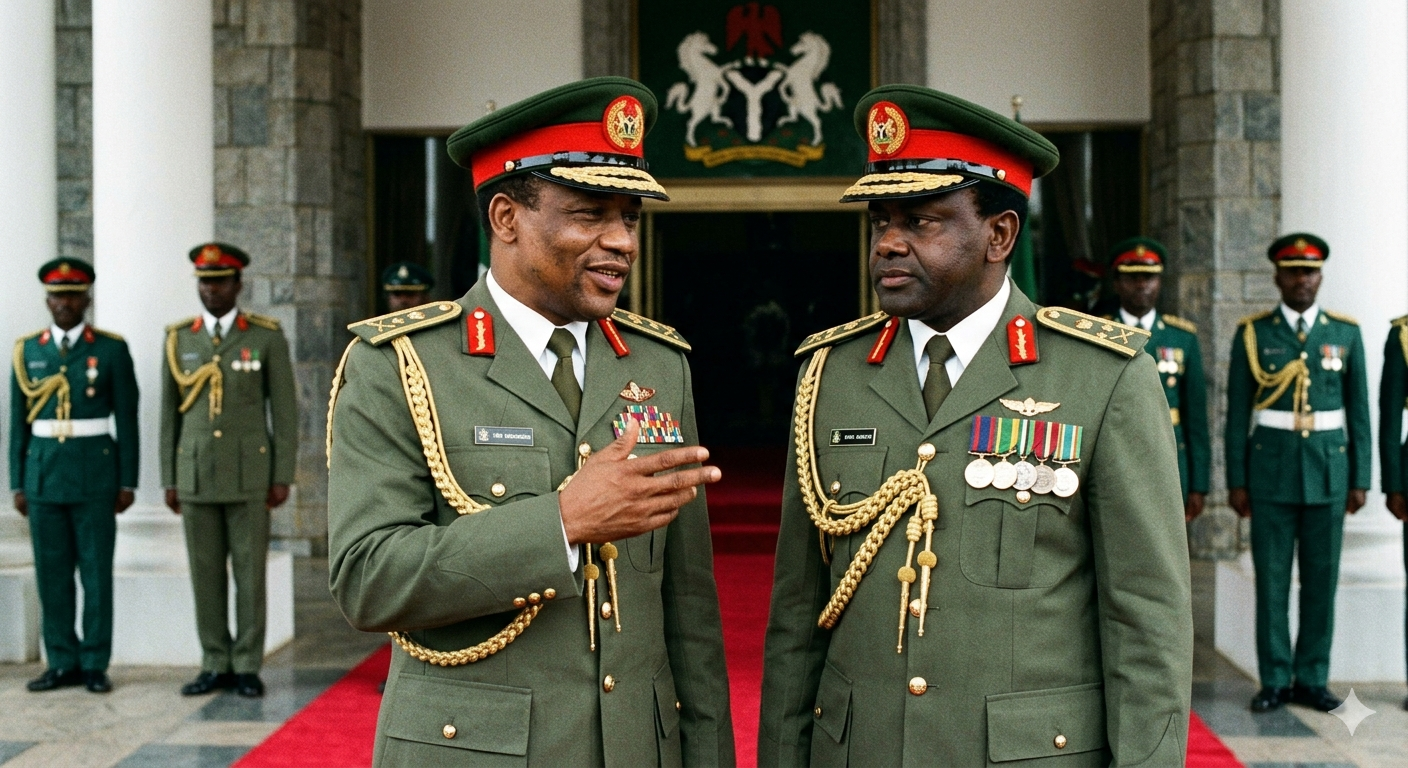
On the night of August 26, 1985, Major-General Sani Abacha left Ibadan for Lagos with only a small team in two cars. He had been designated as Chief of Army Staff if the coup against General Muhammadu Buhari succeeded. The operation was led by Buhari’s Chief of Army Staff, Major-General Ibrahim Babangida.
What happened next has remained a subject of intense historical debate for decades. Babangida reportedly prevented Abacha from moving troops from the 2nd Mechanised Infantry Division in Ibadan. Instead, Abacha was given soldiers from the Presidential Brigade of Guards and the Armoured Corps already stationed in Lagos.
The Two Competing Narratives
The most common explanation is that Babangida feared a “coup within a coup.” By limiting Abacha’s troop movement, Babangida ensured he would not be arrested or sidelined upon his arrival in Lagos to be declared Head of State. This view suggests that even among coup plotters, there was deep suspicion and power play.
However, another perspective argues that the decision was driven more by operational and tactical considerations than personal distrust. Moving a large number of troops from Ibadan to Lagos on the day of the coup would have been extremely risky. Such a noticeable troop movement over that distance could easily have been detected by the government, thereby alerting them to the plot before it could be executed.
In coup planning, secrecy and surprise are critical. Using soldiers already stationed near the target (in this case, Lagos) was a standard military tactic to avoid detection. Therefore, some historians believe Babangida’s decision was a practical one rather than an act of betrayal or fear.
The Bigger Picture in Nigeria’s Military Politics
This episode did not occur in isolation. It reflected the deep culture of suspicion and betrayal that defined Nigeria’s military politics from the 1960s through the 1990s. Officers were constantly watching their backs, even among those they plotted with. The 1966 coups, the 1975 takeover, the 1983 coup, and the 1985 palace coup all showed a pattern where trust was fragile and loyalty was often transactional.
Babangida, known for his strategic thinking, understood the dangers of allowing a potential rival too much independent power during a sensitive operation. At the same time, Abacha was a powerful and respected officer whose support was crucial for the success of the coup. Balancing these interests required careful calculation.
Aftermath and Long-Term Implications
The 1985 coup succeeded with minimal bloodshed. Babangida became Head of State, while Abacha was appointed Chief of Army Staff. For several years, the two men maintained a working relationship, though it was later marked by tension and rivalry, especially during the transition to civilian rule in the early 1990s.
This early episode in 1985 offers insight into how Babangida managed power. He often preferred to keep potential competitors close but under control. It also shows how personal ambition, institutional loyalty, and tactical decisions shaped the outcomes of military interventions in Nigeria.
Why This Matters Historically
The 1985 coup remains one of the most significant in Nigeria’s history because it ended Buhari’s short but harsh regime and ushered in Babangida’s eight-year rule. The way the coup was executed — particularly the restriction placed on Abacha’s movement — highlights the complex web of trust, suspicion, and power that defined military governance in Nigeria.
It also serves as a reminder that even among coup plotters, unity was often superficial. Behind the scenes, calculations were being made about who would control power after the old regime was removed.
In the end, Babangida’s decision to limit Abacha’s troop movement may have been both a tactical necessity and a strategic power play. Whatever the true motive, it helped shape the outcome of the coup and the political trajectory of Nigeria for years to come.
Source: Historical accounts and analysis of the 1985 coup, including works by military historians such as Dr. Nowa Omoigui.
What do you think? Was Babangida’s decision driven more by operational necessity or by fear of a counter-coup? Share your thoughts in the comment section.