

In December 1997, at the height of General Sani Abacha’s iron rule, one of the most powerful men in Nigeria reportedly lost control of his bowels — not once, but twice — out of sheer terror.
The man was Lt. General Oladipo Diya, Abacha’s Chief of General Staff and the second most powerful officer in the country at the time. He had been accused of masterminding a coup plot against the Head of State. What followed was a sequence of events so humiliating that it would later be recounted in graphic detail at the Oputa Panel.
The Videos That Shocked the Nation
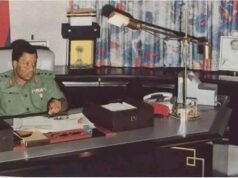
When the alleged coup plot was uncovered, the government released video clips showing Diya on his knees, weeping and begging for his life before Abacha and his Chief Security Officer, Major Hamza Al-Mustapha. In the videos, Diya appeared completely broken, pleading for mercy.
Diya later claimed the videos were doctored. His strongest argument was that the three videos, supposedly recorded on the same day, showed him wearing different clothes — something he insisted was impossible within a few hours.
For a while, many people found his defence believable.
The Explosive Testimony at the Oputa Panel
However, during the Human Rights Violations Investigation Panel (Oputa Panel) in 2000, a devastating testimony was given by General Ibrahim Sabo, who served as the Director of the Directorate of Military Intelligence (DMI) under Abacha.
According to Sabo’s testimony, when Diya was informed that Abacha wanted to see him, he became so terrified that he involuntarily defecated on himself — not once, but twice. The smell was so unbearable that the area had to be fumigated. Sabo revealed that Julius Berger was even called in to clean and disinfect the premises before Diya could be brought before Abacha.
The soiled clothes had to be changed, which explained why Diya appeared in different outfits in the videos.
Diya never challenged or denied General Sabo’s testimony.
The Atmosphere of Fear in Aso Rock
This revelation paints a chilling picture of the psychological terror that pervaded Aso Rock during Abacha’s final years. Even a man as powerful as Diya — someone who sat at the very top of the military hierarchy — was reportedly reduced to a state of complete helplessness when faced with the possibility of Abacha’s wrath.
The fear was not just about physical harm. It was the dread of the unknown — what Abacha, known for his ruthless and unpredictable nature, could do to anyone he perceived as a threat. Senior officers lived in constant suspicion of one another. Loyalty was fragile, and betrayal was often punished without mercy.
Diya’s alleged involvement in the coup plot had placed him in the most dangerous position possible. Being summoned by Abacha under such circumstances was, for many, equivalent to a death sentence.
Why This Story Still Matters
The account of Diya’s breakdown is more than just a sensational story from Nigeria’s military past. It reveals the deep paranoia and psychological warfare that defined Abacha’s regime. It shows how even the most powerful figures could be reduced to nothing when confronted with absolute power.
It also raises questions that historians and analysts continue to debate: How much of Diya’s behaviour was genuine fear, and how much was a calculated performance to save his life? Why did he never publicly challenge Sabo’s graphic testimony if it was false?
Years later, this episode remains one of the most talked-about and humiliating moments of the Abacha era — a stark reminder that behind the iron-fisted image of military rule, there were often scenes of quiet terror, broken men, and shattered egos.
Source: Oputa Panel proceedings