

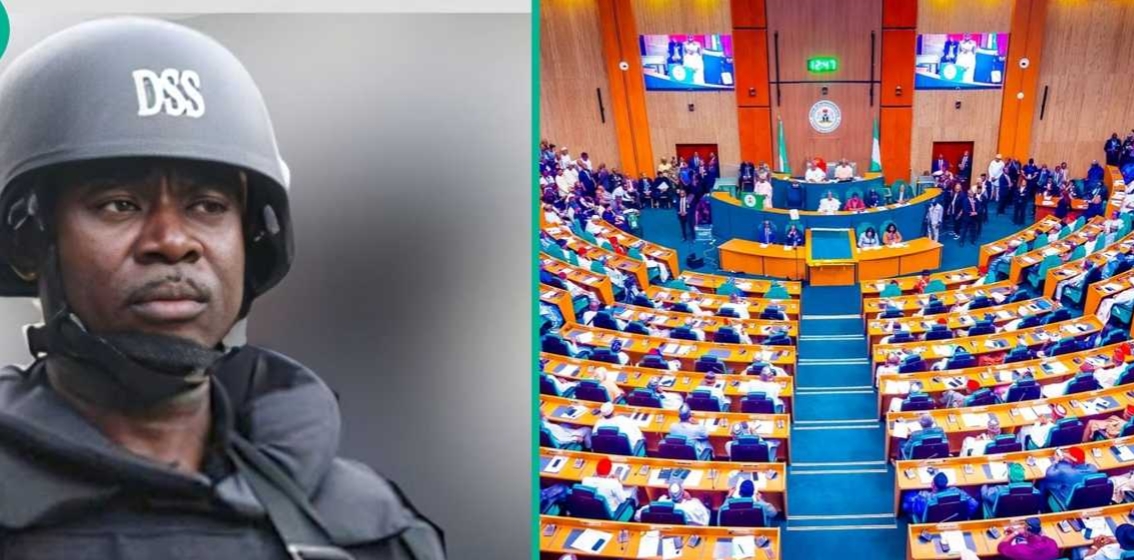
The Department of State Services (DSS) has urged the House of Representatives to remove provisions allowing foreign organisations to contribute funds to a proposed DSS Security Trust Fund, warning that such arrangements could threaten Nigeria’s sovereignty and compromise sensitive security operations.
The position was presented on Thursday during a public hearing organised by the House Committee on National Security and Intelligence, where lawmakers considered bills aimed at strengthening the agency’s operational capacity through improved funding and institutional development.
DSS Raises Concerns Over Foreign Contributions
Representing the DSS at the hearing, Emmanuel Duabry stated that while the agency supports the establishment of the Security Trust Fund, it strongly opposes clauses that permit grants, donations, or endowments from international organisations.
According to the DSS, accepting foreign funding for security-related operations could create risks to operational confidentiality, institutional independence, and national security.
The agency argued that international funding arrangements may come with reporting and disclosure obligations that could expose sensitive intelligence activities, procurement processes, deployment strategies, and intelligence-gathering methods.
The DSS also warned that foreign donors could indirectly influence Nigeria’s security priorities, potentially affecting the country’s ability to independently address challenges such as terrorism, banditry, kidnapping, and other internal security threats.
As a result, the agency recommended that the Trust Fund should only receive financial support from local organisations and domestic sources.
Call for Clear Funding Formula
Beyond its objections to foreign funding, the DSS also proposed changes to the funding structure of the Trust Fund.
The agency argued that the current bill gives excessive discretion to the National Assembly in determining annual allocations. It recommended the adoption of a clearly defined funding formula or a fixed percentage contribution mechanism to ensure predictable and sustainable financing.
Recommendations on Governing Board
The DSS further questioned the inclusion of the Nigerian Governors’ Forum on the proposed governing board of the Trust Fund.
According to the agency, the forum is a voluntary association and lacks statutory recognition.
Instead, the DSS suggested that the Nigerian Bar Association should nominate a representative with expertise in national security and human rights issues.
The agency also proposed that the Board Secretary should be appointed by the President and must be a serving or retired DSS officer not below the rank of Assistant Director, as well as a legal practitioner with at least 10 years of post-call experience.
DSS Opposes Proposed Intelligence Institute
The DSS also expressed reservations about a separate bill seeking to establish a Strategic Intelligence Management Institute.
According to the agency, the proposed institution largely duplicates the functions of the National Institute for Security Studies, which was established under the National Institute for Security Studies Act of 2019.
The DSS recommended that if the institute is eventually established, its mandate should be limited to external intelligence operations and international intelligence cooperation to avoid overlapping responsibilities.
Agency Still Supports Trust Fund Bill
Despite its concerns and proposed amendments, the DSS described the Security Trust Fund bill as an important initiative.
The agency said the legislation would help strengthen intelligence and security operations through sustainable and dedicated funding, urging lawmakers to proceed with its passage after addressing the identified issues.
The debate over the bill comes as Nigeria continues to confront security challenges across several regions, prompting calls for stronger funding mechanisms and improved intelligence capabilities.