

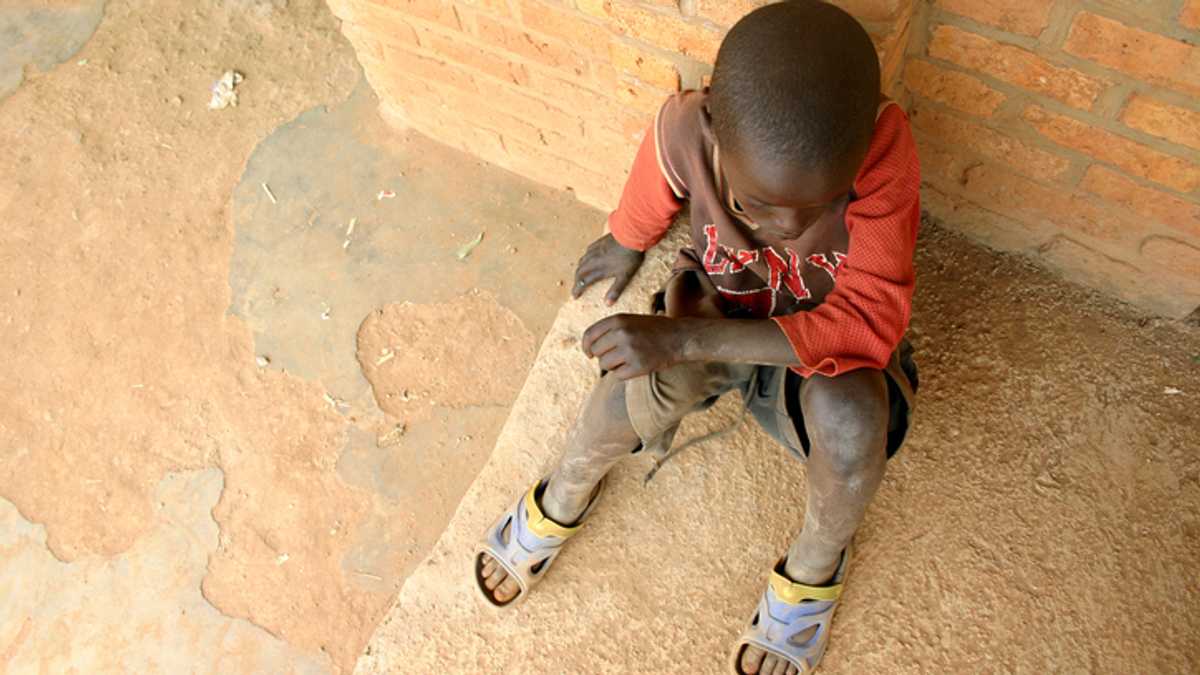
The first time I saw the boy, he was sleeping on a piece of cardboard beside a busy road in Kano.
He couldn’t have been older than ten.
His clothes were torn.
His slippers were different sizes.

And despite the noise of traffic, market traders, and pedestrians, he slept as if exhaustion had completely defeated him.
What caught my attention wasn’t the boy.
It was the woman sitting beside him.
A frail woman with tired eyes and a face that seemed older than her years.
She watched over him silently, occasionally brushing flies away from his face.
I had no idea that meeting them that afternoon would completely change my life.
And reveal a secret that had been hidden for more than a decade.
My name is Nkem.
I am an Igbo woman from Anambra State.
My husband, Chuka, and I had been married for twelve years.
We lived in Enugu.
We had a comfortable life.
A successful business.
A beautiful home.
Everything except one thing.
Children.
For years, we prayed.
Visited hospitals.
Consulted specialists.
Fasted.
Cried.
Hoped.
Waited.
Nothing happened.
Eventually, we accepted that parenthood might never come naturally for us.
It was painful.
But life had to continue.
That particular year, I traveled to Kano for business.
After a meeting, our driver stopped near a crowded junction.
That’s when I noticed the woman and the boy.
Something about them stayed with me.
I don’t know why.
Perhaps it was the way she looked at him.
Even in poverty, there was fierce love in her eyes.
I asked around.
The nearby traders knew them.
The woman’s name was Zainab.
The boy’s name was Ibrahim.
Many people referred to him as an almajiri.
A child surviving mostly on charity and occasional help from strangers.
For the next three days, I kept returning.
Bringing food.
Water.
Medicine.
And gradually, I learned their story.
Or at least the story I thought was true.
According to Zainab, she had nowhere to go.
Her husband had died years earlier.
Life had become unbearable.
The streets had become home.
The boy was all she had left.
The more time I spent with them, the more attached I became.
Especially to Ibrahim.
He was unusually intelligent.
Polite.
Curious.
Despite never having formal education, he could solve problems faster than many children his age.
When my trip ended, I couldn’t stop thinking about him.
Back in Enugu, I told Chuka everything.
For weeks, we discussed it.
Prayed about it.
Considered every possibility.
Then finally, we made a decision.
We would help.
Not just financially.
We wanted to change his life.
After months of legal processes, social welfare involvement, and difficult conversations, Zainab agreed.
She said she wanted a future for her son.
A future she could never provide.
The day Ibrahim arrived at our home remains one of the happiest days of my life.
For the first time, the house felt alive.
Laughter returned.
Hope returned.
Purpose returned.
The adjustment wasn’t easy.
He struggled with English.
He struggled with formal schooling.
He struggled with trusting people.
But slowly, things improved.
Within a few years, he became one of the top students in his class.
Teachers loved him.
Neighbors admired him.
Friends respected him.
He was everything we could have hoped for.
Then came the day everything changed.
Ibrahim was seventeen.
One evening, my husband was helping him complete university admission paperwork.
Routine documents.
Nothing unusual.
Or so we thought.
Then Chuka noticed something strange.
A birth certificate.
Old.
Worn.
Partially damaged.
Hidden among Ibrahim’s belongings.
The name on the document wasn’t Ibrahim.
We both assumed it was an error.
Until Chuka looked closer.
The listed parents were not Zainab and her late husband.
In fact, neither name matched anyone we knew.
At first, we thought the document might belong to someone else.
But the birth date matched perfectly.
The hospital details matched.
Everything matched.
Except the names.
My husband became suspicious.
Very suspicious.
The next few weeks became a whirlwind of questions.
Records were checked.
Officials were contacted.
Old files were reopened.
And eventually, a shocking truth emerged.
The woman we knew as Zainab was not Ibrahim’s biological mother.
The room went silent when investigators revealed it.
Years earlier, during a violent communal conflict in northern Nigeria, several families had been displaced.
Among the chaos, a young child had become separated from his parents.
That child was Ibrahim.
He had been barely three years old.
Too young to remember anything.
Authorities searched extensively at the time.
But no relatives were found.
No records led anywhere.
The child was eventually presumed permanently lost.
Then came the twist nobody expected.
Zainab had found him.
Alone.
Terrified.
Hungry.
Wandering near a temporary camp.
She could have abandoned him.
Ignored him.
Walked away.
Instead, she took him in.
Fed him.
Protected him.
Raised him.
Loved him.
Even when she became homeless herself.
Even when she barely had enough food.
Even when survival became a daily struggle.
For years, she carried a secret.
Not because she wanted to steal someone’s child.
But because she genuinely believed his family was gone forever.
The investigation continued.
And against all odds, authorities located surviving relatives.
Not just relatives.
His parents.
Alive.
I will never forget the day we met them.
His biological mother collapsed in tears before even reaching him.
His father could barely speak.
For fourteen years, they had believed their son was dead.
And now he stood before them.
Alive.
Healthy.
Educated.
Loved.
The reunion was emotional beyond words.
There wasn’t a dry eye in the room.
Not among the officials.
Not among the relatives.
Not among us.
Then something happened that surprised everyone.
His biological father approached Zainab.
The woman who had raised his son.
The woman who had protected him through unimaginable hardship.
He knelt before her.
And thanked her.
The entire room broke down in tears.
Because everyone understood the truth.
Yes, she had hidden important information.
Yes, mistakes had been made.
But without her, that little boy might never have survived at all.
Today, Ibrahim is a successful engineer.
He has relationships with both families.
His biological parents.
And us.
The family who adopted him.
People often ask who his “real” mother is.
The answer is simple.
Sometimes life is too complicated for one answer.
The woman who gave him life was his mother.
The woman who saved his life was also his mother.
And the woman who helped shape his future became part of that story too.
Looking back, I realize something remarkable.
When I first saw a tired almajiri boy sleeping beside a road in Kano, I thought I was rescuing a child.
I had no idea that years later, my husband would uncover a secret that would reunite an entire family, heal old wounds, and reveal that behind one homeless boy’s story was a miracle nobody saw coming.
Source: Original This story is inspired by the real experiences of our readers. We believe that every story carries a lesson that can bring light to others. To protect everyone’s privacy, our editors may change names, locations, and certain details while keeping the heart of the story true. Images are for illustration only. If you’d like to share your own experience, please contact us via email.