
Two Leaders, Two Tragic Ends: Tafawa Balewa and John F. Kennedy — A Photograph That Captures Lost Hope
 Follow on Google News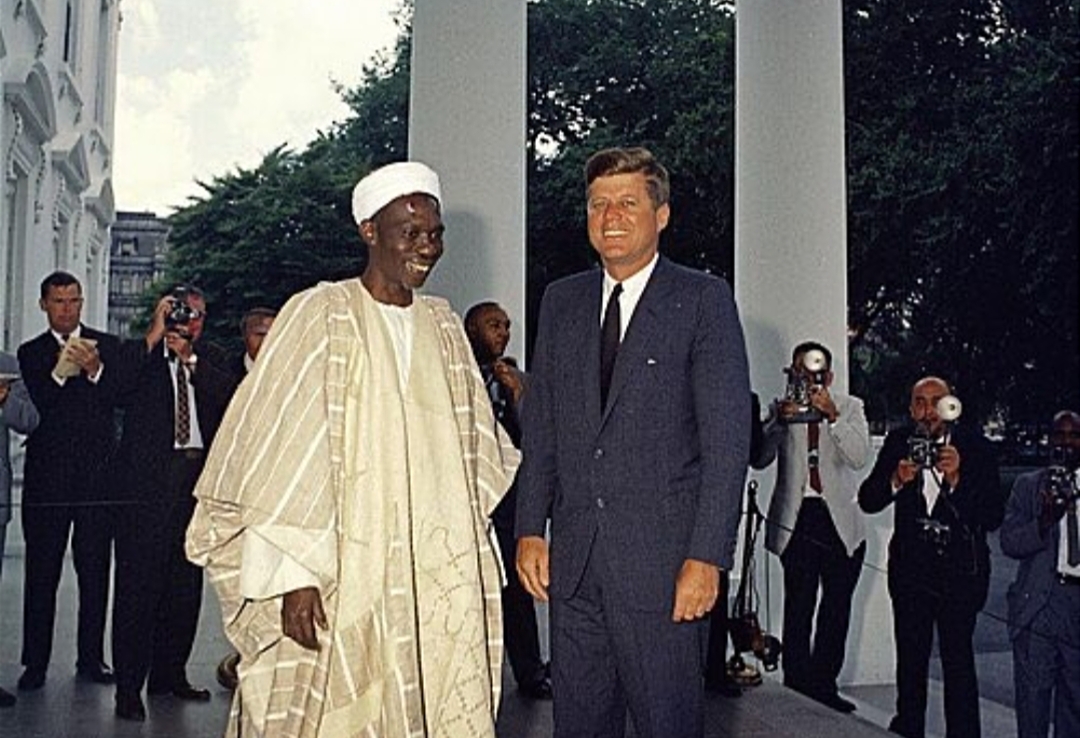
n a black-and-white photograph taken at the White House, Nigeria’s first Prime Minister, Sir Abubakar Tafawa Balewa, stands beside U.S. President John F. Kennedy. Both men are smiling, exuding confidence and optimism. It is the early 1960s — a time of new nations, new beginnings, and immense possibility. Balewa represented a young, independent Nigeria full of promise. Kennedy embodied the vigour of post-war America.
Neither man could have imagined that, within just a few years, both would be violently removed from power and from this world.
The Historical Setting: Hope in the Early 1960s
Nigeria had gained independence in 1960. Tafawa Balewa, a soft-spoken Northern politician and schoolteacher-turned-statesman, became the country’s first Prime Minister. He was widely respected for his moderation, diplomatic skills, and commitment to national unity in a deeply divided federation.
The United States, under the young and charismatic President Kennedy, was positioning itself as a leader of the free world during the Cold War. Kennedy’s administration saw newly independent African nations as key battlegrounds against Soviet influence. Balewa’s visit to the White House symbolised Nigeria’s emergence on the global stage and the warm relations between the two countries.
The Main Players and Their Tragic Fates
– Sir Abubakar Tafawa Balewa — Often called the “Golden Voice of Africa” for his eloquence. As Prime Minister, he navigated the delicate ethnic and regional politics of the First Republic. He was killed during Nigeria’s first military coup on January 15, 1966. His body was later discovered in a bush near Lagos. His death marked the violent end of Nigeria’s First Republic and the beginning of decades of military rule.
– John F. Kennedy — The youngest elected U.S. President, known for his idealism, the Peace Corps, and the space race. He was assassinated in Dallas, Texas, on November 22, 1963, in one of the most shocking events of the 20th century.
Both men died in their prime, cut down by violence at moments when their countries looked to them for leadership and unity.
The Hidden Tensions and What the Photo Doesn’t Show
The photograph captures a moment of international goodwill, but behind the smiles lay deep domestic challenges. In Nigeria, ethnic and regional rivalries were already simmering — tensions that would explode into the 1966 coup. Balewa was often caught between the more radical aspirations of Southern leaders and the conservative interests of the North.
Kennedy faced his own crises: civil rights struggles at home, the Bay of Pigs, and the Cuban Missile Crisis. Both leaders were navigating fragile young systems under immense pressure.
The Consequences
Balewa’s assassination triggered a chain of events — counter-coup, pogroms, and eventually the Nigerian Civil War (1967–1970) — that profoundly shaped the country’s history. Nigeria lost one of its most unifying figures at a critical juncture.
Kennedy’s death plunged America into mourning and altered the course of U.S. politics, foreign policy, and the civil rights movement. His successor, Lyndon Johnson, continued some policies but faced the escalating Vietnam War.
Why This Story Still Matters Today
The image of Balewa and Kennedy together is a poignant reminder of how quickly hope can turn to tragedy in politics. Both men represented a certain idealism — Balewa for a united, stable Nigeria; Kennedy for a more just and ambitious America. Their violent deaths symbolise the fragility of leadership and the enduring power of violence to reshape nations.
In contemporary Nigeria, where leadership, unity, and governance remain perennial challenges, Balewa’s legacy as a bridge-builder and statesman is often invoked with nostalgia. The photograph also serves as a broader meditation on power: it is temporary, and history can be cruel to even the most promising figures.
As the Instagram post aptly notes: “History often reminds us that power is temporary, but moments like these live forever.”
This single image from the White House stands as a powerful testament to lost potential — two leaders, two nations, two tragic endings. It invites reflection on what Nigeria and the world might have been had these men lived longer.
A timeless photograph that continues to evoke both admiration and melancholy.







Comments
0 comments