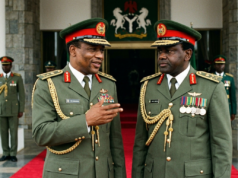

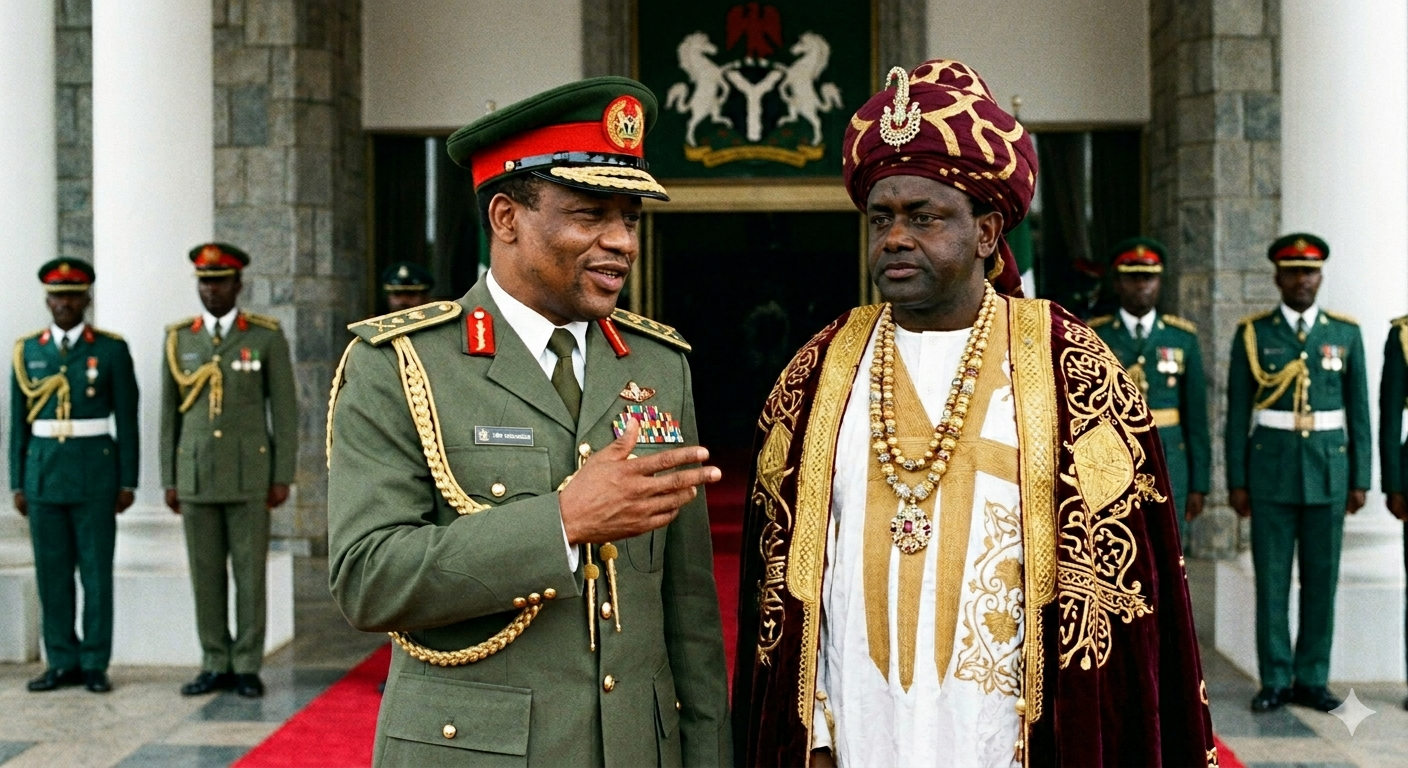
One of the most intriguing aspects of the relationship between former military President General Ibrahim Babangida (IBB) and his close ally, General Sani Abacha, was the nickname “Khalifa” (an Arabic term meaning “successor” or “caliph”), which Babangida reportedly began using for Abacha after a major crisis.
The nickname gained prominence following the dramatic events of the failed Gideon Orkar coup attempt on April 22, 1990. During the early hours of that day, young officers led by Major Gideon Orkar launched a violent assault on Dodan Barracks in Lagos, killing Babangida’s Aide-de-Camp, Lt. Col. U.K. Bello, and trapping the President and his family inside the State House.
In the midst of the chaos, then-Chief of Army Staff Major General Sani Abacha played a decisive role in crushing the coup. He led a fierce counteroffensive that restored order and saved Babangida’s government. Abacha’s unwavering loyalty during this critical moment greatly strengthened the bond between the two men.
As a mark of appreciation and trust, Babangida promoted Abacha to the rank of full four-star General — an unprecedented move at the time for a serving officer while a Head of State was in office. It was around this period that Babangida began referring to him as “Khalifa,” signalling that Abacha was being viewed as a potential successor or the next in line within the military hierarchy.
The nickname reflected not only gratitude for Abacha’s role in protecting the regime but also the deep political and personal alliance between the two officers, who had collaborated in previous coups, including the 1985 palace coup that brought Babangida to power.
Historical Context:
Babangida and Abacha had a long-standing relationship dating back to their early military careers. Abacha was a key figure in the 1985 coup that ousted General Muhammadu Buhari and installed Babangida. Their partnership was often described as complementary: Babangida with his charisma and political astuteness, and Abacha with his discipline, loyalty, and ruthlessness in handling security threats.
However, the relationship later became strained, particularly around the June 12, 1993 election annulment and Babangida’s eventual “stepping aside,” leading to Abacha taking power in 1993.
The “Khalifa” moniker remains a fascinating footnote in Nigeria’s military history, symbolising loyalty, power dynamics, and the complex bonds among the country’s military elite during the turbulent 1980s and early 1990s.
Sources:
– The Cable (historical archive on Babangida-Abacha relationship)
– Gamji.com military history compilations
– Accounts from Professor Omo Omoruyi’s *The Tale of June 12*
What are your thoughts on the Babangida-Abacha alliance and the “Khalifa” nickname? Share in the comments.