
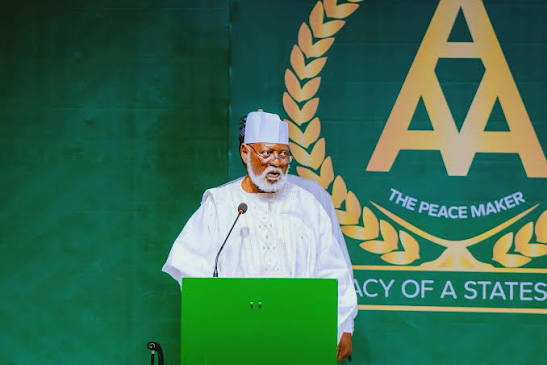
Former Nigerian Head of State, Abdulsalami Abubakar, has revealed that he once advised Olusegun Obasanjo not to contest for the presidency following his release from prison in 1998.
The revelation is contained in Abdulsalami’s newly launched autobiography, Call of Duty, a 264-page memoir unveiled in Abuja during activities marking his 84th birthday.
According to the retired general, Obasanjo visited him shortly after regaining his freedom, and he urged him to focus on rebuilding his life rather than pursuing political office.
“I advised him to return home and thank God that he was still alive after all he had gone through in four years. I told him point-blank that he should forget about contesting to be President,” Abdulsalami wrote.
Despite the advice, Obasanjo went ahead with his presidential ambition and eventually won the 1999 election that ushered Nigeria into a new democratic era.
Abdulsalami Denies Backing Obasanjo’s Presidential Ambition
The former military ruler maintained that his administration did not sponsor or endorse Obasanjo’s candidacy.
He stated that claims suggesting the military government deliberately installed Obasanjo as president were inaccurate.
According to him, the democratic process that produced the former president was independent of his administration.
Obasanjo Considered Suing the Federal Government
Abdulsalami also disclosed that Obasanjo contemplated legal action against the Federal Government over his imprisonment.
However, he said he persuaded the former military ruler to abandon the idea, arguing that court proceedings could be lengthy and unpredictable.
Instead, Abdulsalami offered to look into compensation for the economic losses Obasanjo suffered while incarcerated, particularly the collapse of some of his business interests.
How Alliance for Democracy Was Registered
In another revelation, Abdulsalami explained that the electoral guidelines were adjusted to allow the registration of the Alliance for Democracy (AD), despite the party not initially meeting the required conditions.
He said the decision was taken to ensure political inclusion and prevent feelings of marginalisation in the South-West region.
According to him, the rules were modified to permit the party that finished third in the registration exercise to qualify, a move that enabled AD to emerge as a registered political party.
Why the Handover Date Shifted to May 29, 1999
The former Head of State also explained why the transition from military to civilian rule eventually took place on May 29, 1999, instead of the earlier timeline proposed during the late Sani Abacha administration.
He noted that the judiciary requested additional time to resolve election-related disputes after the polls, making May 1999 the most practical date for the transfer of power.
Resisted Pressure to Extend Military Rule
Abdulsalami revealed that he faced pressure from various quarters to remain in office longer than planned.
According to him, some military colleagues, regional leaders, and political stakeholders believed more time was needed before a return to democratic governance.
However, he insisted he was determined to hand over power as quickly as possible, believing the country needed stability and a return to civilian leadership.
“For me, I was not in any way tempted to stay longer in office. I had made up my mind.”
A Peaceful Democratic Transition
On May 29, 1999, Abdulsalami formally handed over power to Obasanjo, bringing an end to years of military rule in Nigeria.
Reflecting on the moment, he described the journey back to Minna after the inauguration as one of the happiest days of his life, saying he felt fulfilled seeing Nigeria successfully complete its transition to democracy.
The memoir provides fresh insight into one of the most significant periods in Nigeria’s political history and the behind-the-scenes decisions that shaped the country’s return to democratic governance.