
The Moment the Cameras Captured
Just after midday on 20 October 2011, a group of fighters from Misrata’s militias peered into the mouth of a large concrete drainage pipe beneath a highway outside Sirte. Inside, covered in dust, blood, and filth, crouched the man who had ruled Libya for 42 years. Muammar Gaddafi emerged slowly, dazed and wounded. Cell phone cameras rolled as fighters dragged him into the harsh sunlight. He was beaten, stabbed, and humiliated on the spot. One of the most famous clips captures a disoriented Gaddafi asking his captors, “What did I do to you?” Another fighter’s retort, preserved in the footage, cut to the core of years of accumulated rage: “You killed our people for 42 years…”
Minutes later he was dead — shot at close range. His body, along with that of his son Mutasim, would soon be displayed in a Misrata freezer for public viewing. The images shocked the world. But the video only showed the final, chaotic minutes. The real story of how Libya’s “Brother Leader” reached that pipe reveals deeper calculations, battlefield revenge, and the fatal absence of any plan for what came after.
Libya in Flames: The Setting of October 2011
By autumn 2011 the Arab Spring had turned Libya into a full-scale civil war. What began as protests in Benghazi in mid-February had escalated into armed rebellion after Gaddafi’s forces opened fire on demonstrators. The National Transitional Council (NTC), a loose coalition of defectors, exiles, and local militias, declared itself the legitimate government. In March the UN Security Council authorised a no-fly zone. NATO’s Operation Unified Protector quickly moved from protecting civilians to actively supporting the rebels with airstrikes, intelligence, and special forces on the ground.
Tripoli fell in August. Only Sirte — Gaddafi’s birthplace and a heavily fortified loyalist stronghold — remained. For weeks NTC forces, spearheaded by battle-hardened Misrata militias, had shelled and besieged the coastal city. Buildings were rubble. Neighbourhoods were gutted. Gaddafi’s remaining forces fought with the desperation of men who knew there would be no mercy. Inside the shrinking pocket, the 69-year-old leader still believed he could outlast his enemies or rally enough tribes to turn the tide.
The Main Players and Their Stakes
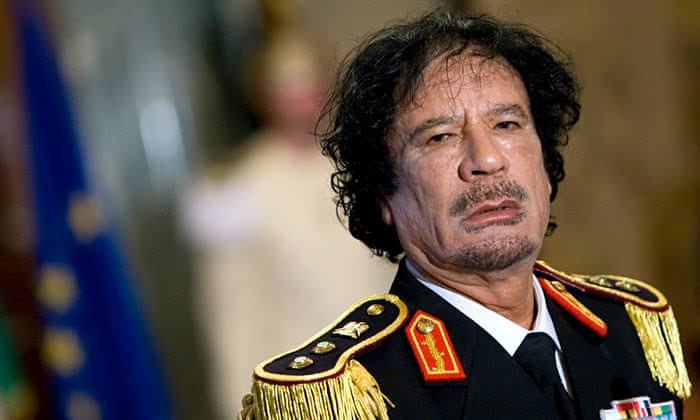
Muammar Gaddafi had seized power in a 1969 coup. He ruled through a unique blend of revolutionary rhetoric (the Green Book), oil-funded patronage, tribal balancing, and brutal repression. He had no formal institutions, no clear succession, and a cult of personality that convinced him — until the very end — that Libyans loved him.
His inner circle that day included his son Mutasim (national security adviser who had taken a leading role in Sirte’s defence), longtime defence minister Abu Bakr Younis Jabr, and security coordinator Mansour Dhao. On the other side stood the NTC’s political leadership (Mustafa Abdul Jalil and Mahmoud Jibril) and, crucially, the Misrata fighters on the ground. These men had endured months of siege warfare, watched their city bombarded earlier in the war, and carried personal scores stretching back decades.
NATO pilots and commanders operated with a different calculus: end the war quickly, degrade loyalist command-and-control, and avoid a prolonged insurgency.
The Hidden Tensions No One Wanted to Admit
Gaddafi’s regime had hollowed out the state. There were no functioning ministries, no professional army loyal to the nation rather than the leader, and no tradition of peaceful power transfer. His defiance — broadcasting defiant audio messages even as his territory shrank — was part bravado, part genuine belief in his own myth.
On the rebel side, the NTC was a fragile umbrella. Field commanders, especially from Misrata, operated with significant autonomy. Many had suffered directly under Gaddafi’s forces. The international community wanted Gaddafi captured alive for trial at the ICC (an arrest warrant had been issued in June). The fighters on the ground had other ideas.
The Critical Morning of 20 October
At dawn the decision was made inside the shrinking Sirte pocket: attempt a breakout south toward Jarif. A convoy of roughly 40–50 vehicles, including Gaddafi’s, rolled out around 8:30 a.m. NATO aircraft — French jets and at least one American drone — had already been tracking movement. The strike was devastating. Vehicles exploded. Dozens died. Survivors, including Gaddafi, Mutasim, and a handful of bodyguards, abandoned the vehicles and fled on foot through fields and trees toward a major road with two large drainage culverts running beneath it.
Gaddafi and a few guards crawled into one of the filthy concrete pipes. Some bodyguards were killed at the entrance. The group waited in the darkness, listening to the sounds of battle above.

What Happened in the Pipe and on the Road
Around 12:30 p.m. Misrata fighters searching the area after the airstrikes discovered the pipes. They called for the occupants to come out. Gaddafi emerged wounded and disoriented. The cell phone footage begins here: he is pulled, beaten, and stabbed. One fighter later told reporters the dictator had begged for his life. The famous line “What did I do to you?” was captured on video.
He was loaded onto a pickup truck. During the chaotic journey toward Misrata — or possibly still at the scene — he was shot multiple times, including in the head at close range. Human Rights Watch’s subsequent investigation concluded he was captured alive, subjected to abuse, and killed while in custody. The official NTC story of death in “crossfire” during a rescue attempt by loyalists does not match the footage or forensic evidence.
Mutasim Gaddafi was captured separately in Sirte the same day. Filmed alive and talking in Misrata custody, he was dead by evening with fresh wounds consistent with execution in custody. His body was later displayed beside his father’s.
The Consequences No One Planned For
The images of Gaddafi’s bloodied face and the public display of his body in a Misrata commercial freezer spread instantly across the world. Some Libyans celebrated the end of a tyrant. International observers condemned the desecration and summary execution. The NTC had lost control of the narrative — and of the fighters on the ground.
Libya had no institutions ready to fill the vacuum. Militias kept their weapons. Power struggles between Misrata, Zintan, Islamist groups, and regional players quickly emerged. The country slid into fragmentation, a second civil war in 2014, and years of proxy conflict involving Turkey, the UAE, Russia, and others. Weapons from Libya’s vast stockpiles flooded the Sahel, fuelling insurgencies across Africa. Europe faced a migration crisis partly rooted in the post-2011 collapse.
Gaddafi was buried in an unmarked desert grave near Sirte. His family scattered into exile or captivity. Saif al-Islam, once seen as a possible reformer, was captured, tried, and later released into eastern Libya’s political scene.
Why the Story Still Matters
The drainage pipe outside Sirte was not just the end of one man. It was the moment a personalised, institution-free regime met its violent conclusion — and left nothing coherent behind. NATO achieved its military objective but had no plan for the morning after. The Misrata fighters achieved revenge but helped unleash years of instability. The cell phone videos that documented Gaddafi’s humiliation also recorded the moment when summary justice replaced any hope of accountability or reconciliation.
More than a decade later, Libya remains divided, its oil wealth contested, and its people still living with the consequences of that October afternoon. The question Gaddafi reportedly asked in his final moments — “What did I do to you?” — was answered on the battlefield. The harder question — what came next, and who was responsible for building it — was never seriously addressed. That unanswered question continues to shape North Africa and the wider region today.