
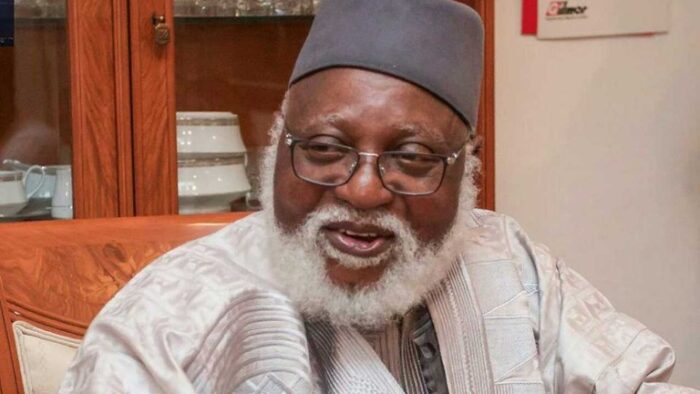
In the grand theatre of Nigerian history, some decisions appear small and almost forgettable when they are made, yet decades later they reveal themselves as the quiet forces that redirect the destiny of both a man and a nation. General Ibrahim Babangida, one of the most calculating leaders to ever rule Nigeria, recently offered a profound and revealing reflection on one such moment involving General Abdulsalami Abubakar.
Babangida’s words carry the weight of lived experience. He points out that a single career decision made by the young Abdulsalami in 1966 quietly positioned him inside the one institution that would dominate Nigeria’s political leadership for more than three decades. That choice from switching from the Nigerian Air Force to the Nigerian Army, Babangida argues, fundamentally altered the course of Abdulsalami’s life and placed him on a path that would eventually lead him to the highest office in the land at one of the most critical junctures in the country’s history.
The mid-1960s were a time of coups, counter-coups, assassinations, and the looming threat of civil war. Real power had shifted decisively into the hands of one particular arm of the military. Those who belonged to the right institution at the right time found themselves at the centre of events that would shape the future of Africa’s most populous nation. Babangida understood this better than most. He knew how institutional alignment, timing, and strategic positioning could turn an ordinary officer into a man of destiny.
Abdulsalami’s early decision embedded him deeply within that powerful structure. It was a move that many would later see as the invisible hand that guided his steady, almost inevitable rise through the ranks — from a dedicated young officer to one of the most senior and respected figures in the armed forces.
Over the following decades, Abdulsalami built a reputation as a calm, professional, and dependable leader. He avoided unnecessary controversy and earned the trust of both colleagues and superiors. By 1998, when General Sani Abacha died suddenly, Abdulsalami had risen to the position of Chief of Defence Staff. In the tense power vacuum that followed, the military establishment turned to him as a consensus figure capable of steadying a deeply fractured nation.
His emergence as Head of State was no coincidence. It was the logical culmination of a career path set in motion more than thirty years earlier. Babangida’s reflection adds dramatic weight to this truth: without that early choice, Abdulsalami might have lived out a distinguished but largely apolitical career far removed from the centre of national power.
In just eleven months, Abdulsalami achieved what many considered impossible. He stabilised a traumatised country, released political prisoners, liberalised the political space, and successfully handed over power to a civilian government on May 29, 1999 — ending sixteen years of unbroken military rule and giving birth to Nigeria’s Fourth Republic.
Babangida’s observation makes the achievement even more fascinating. It suggests that Abdulsalami’s entire journey — from that single decision in 1966 to the man who midwifed Nigeria’s return to democracy — was profoundly influenced by one quiet move made when he was still a young officer. What looked like a routine career adjustment at the time became the foundation of one of the most consequential transitions in the nation’s history.
This revelation from Babangida offers a rare, human glimpse into how personal choices intersect with national destiny. In Nigeria’s story of coups, ambition, and survival, Abdulsalami’s path stands out as one of quiet preparation meeting a moment of profound crisis.
The story is both dramatic and instructive. Sometimes the most powerful forces in history are not loud declarations or grand strategies, but small, almost invisible decisions whose full impact only becomes clear many years later — when a man finds himself exactly where his country needs him most.
Source: General Ibrahim Babangida’s reflections, as reported by Premium Times NG.
What do you think about Babangida’s observation? How much do you believe early career choices shape the destiny of leaders and nations? Share your thoughts in the comment section.